
 Chris Chatterton
Know Your Audience:
Design for Audiences – Not for content
Most organisations understand the importance of knowing their audience. They invest in research, develop personas, map customer journeys and document the needs of the people they want to engage. Yet despite the effort involved, much of this work is rarely revisited once the initial website, campaign or digital transformation project is complete.
The problem isn’t that audience research lacks value. It’s that traditional approaches often produce something difficult to maintain and even harder to use in everyday decision-making. What begins as an exercise in understanding people can become a collection of documents that teams refer to during a project, but rarely use as part of their ongoing marketing and digital activities.
At AlphaSys, we believe audience understanding should be a repeatable business practice, not a deliverable produced during a project. Our Know Your Audience methodology uses a simple, three-dimensional model that helps organisations make practical decisions about their websites, marketing, content and digital experiences. Rather than trying to describe every possible type of person, we focus on a small number of meaningful distinctions that influence how organisations engage their audiences.
Know Your Audience is an important part of how we approach building sustainable digital systems. Understanding audiences comes before designing content structures, navigation and digital experiences. But the value of this work extends well beyond a website project. The same audience understanding can inform marketing, social engagement, email communications, CRM journeys and the ongoing decisions organisations make about how to engage their communities.
Thinking about personas differently
Traditional personas attempt to describe an audience through a collection of representative individuals, often including their age, occupation, motivations, interests, challenges and behaviours. While these can be useful for developing empathy, they can also become unnecessarily complicated. Organisations invest considerable time developing detailed personas that marketing teams rarely revisit once the initial project is complete.
At AlphaSys, we think about personas differently. As part of our Know Your Audience discovery process, we use a simple collection of eight recognisable personas to help you think about the different people who engage with your organisation.
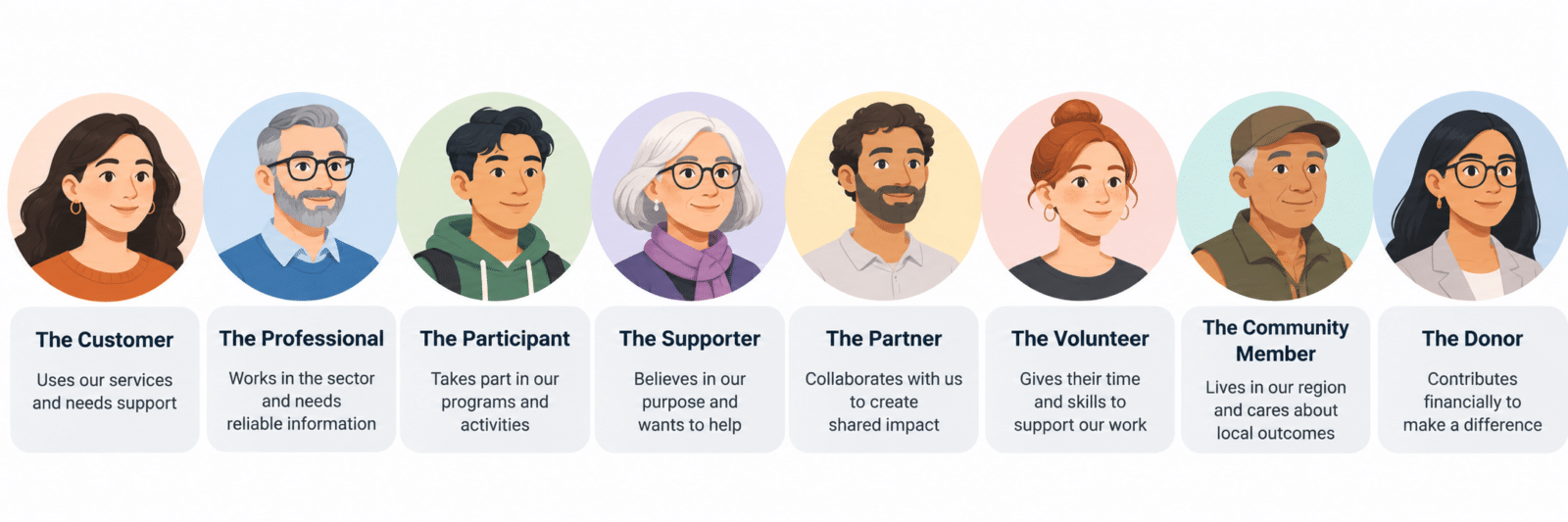
Rather than asking you to develop detailed fictional profiles, we simply ask you to consider these eight personas and tell us which ones align with your audiences and why. You might recognise several immediately, find that some overlap, or identify people who don’t fit neatly into any of them. That’s all useful information.
The purpose isn’t to create another set of personas for your organisation to maintain. It’s to start a practical conversation about who your audiences are, how they relate to your organisation and what makes them different. From that conversation, we can begin identifying the three or four meaningful audience archetypes that will form the foundation of your engagement model.
Introducing the 3D Audience Model
Our Know Your Audience methodology separates audience understanding into three dimensions: archetypes, interests and engagement lifecycle. Each answers a different question, and together they provide a practical way to understand who we’re engaging, what matters to them and how their relationship with the organisation should influence the experience we provide.
The first dimension is archetypes: who are they? Archetypes describe the broad groups of people who interact with an organisation, such as customers, members, supporters, professionals, partners or community participants. The objective isn’t to describe every characteristic of each person, but to identify the meaningful differences between groups that influence how the organisation should engage them.
The second dimension is interests: what matters to them? Interests describe the subjects, services, opportunities or outcomes people care about. Unlike traditional personas, interests aren’t permanently attached to a particular archetype. Two very different groups of people might share an interest, while people within the same archetype might care about completely different things. Separating interests from archetypes allows us to recognise these relationships without creating a new persona for every possible combination.
We deliberately encourage organisations to identify just three or four archetypes and three or four interests. This can be challenging because there are always exceptions, overlapping relationships and additional groups or topics to consider. However, the discipline forces us to focus on distinctions that actually influence engagement decisions, rather than attempting to catalogue every variation.
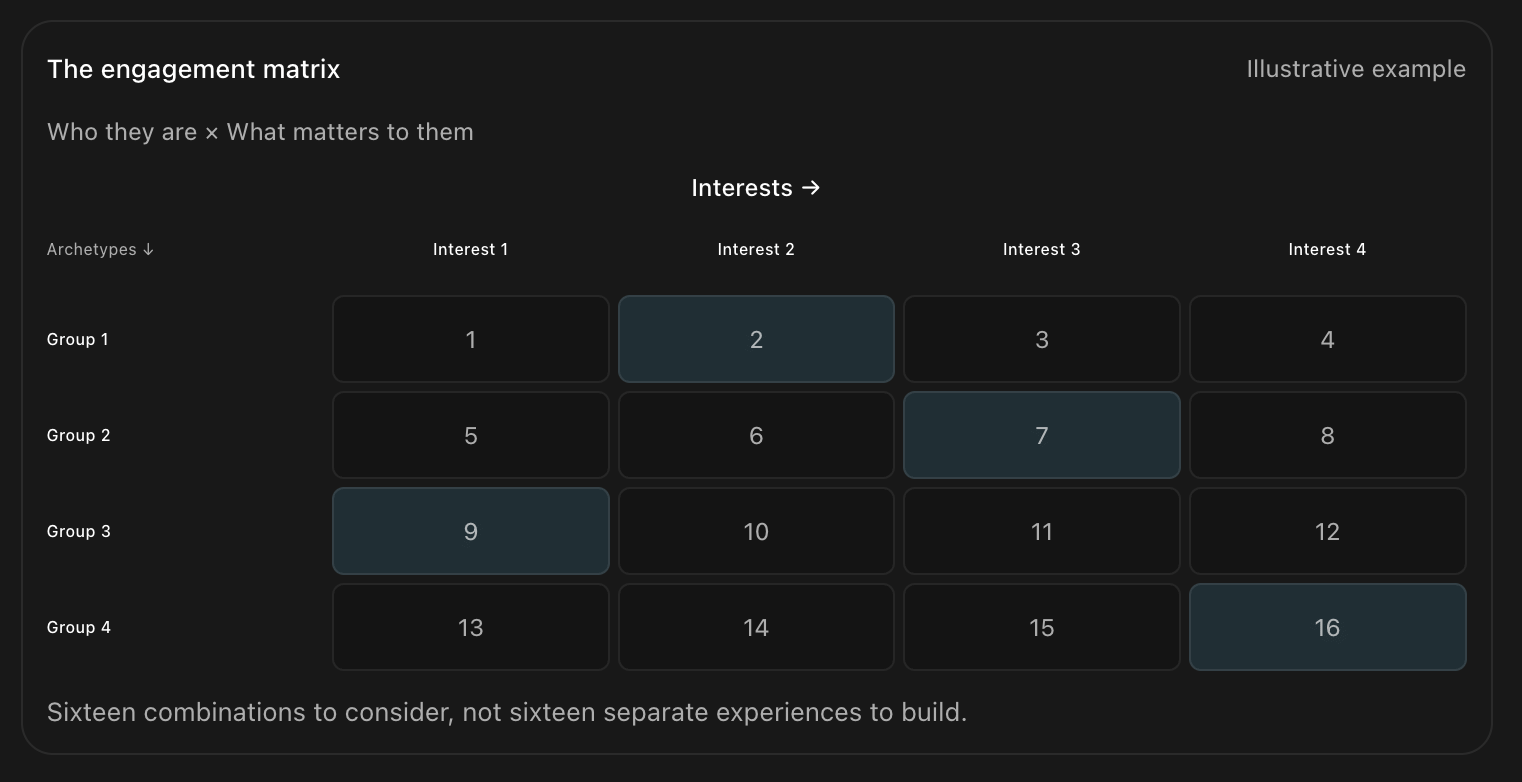
Combining archetypes and interests creates a simple two-dimensional engagement matrix. With four archetypes and four interests, we have 16 possible audience combinations, each representing a different engagement opportunity. Not every combination will be equally important, and some may have little relevance to the organisation. Understanding those differences is part of what makes the matrix useful.
The third dimension is engagement lifecycle: where are they in their relationship with us? Someone discovering an organisation for the first time has very different needs from someone who has been actively involved for years. Their familiarity, trust, expectations and willingness to engage will all influence the experience they need.

A simple lifecycle might move through five stages: Unaware, Discover, Engage, Participate and Advocate. At the earliest stages, audiences are often anonymous. They may discover an organisation through search, social media, referrals or independently exploring its website. We don’t necessarily know who they are, and we cannot assume they will give us much time to establish relevance. As relationships develop, people may become known to the organisation, allowing us to provide more relevant experiences and proactive communications where appropriate permissions exist.
The lifecycle isn’t necessarily linear, and someone can be at different stages with different services or interests. Its purpose is to help us consider the nature of the relationship rather than assuming every visitor or contact should receive the same experience. When combined with the engagement matrix, it adds context to each audience combination and helps us understand how engagement might change as relationships develop.
Simplicity is a deliberate design decision
One of the hardest parts of our methodology is resisting the temptation to add more detail. There is always another archetype to consider, another interest to capture or another exception that doesn’t fit neatly into the model. Each addition can make the framework feel more accurate, but it also increases the number of combinations that teams need to understand and manage.
More fidelity doesn’t automatically produce better decisions. In many cases, it simply produces a more complicated model that becomes increasingly difficult to maintain. A framework with dozens of audience categories might describe an organisation’s audience in considerable detail, but if marketing teams cannot confidently use it to make everyday decisions, that additional complexity provides limited practical value.
A four-by-four engagement matrix provides 16 audience combinations. Considering these against five lifecycle stages introduces multiple perspectives on engagement, but it doesn’t mean an organisation needs 80 different campaigns, journeys or website experiences. The model is intended to guide decisions, not multiply deliverables.
Instead, we look for common needs that can be served through shared experiences, meaningful differences that justify more tailored engagement, and audience combinations that matter most to the organisation’s objectives. The result is a manageable framework that teams can remember, discuss and apply consistently, without needing to return to a large collection of research documents.
From audience understanding to digital decisions
The real value of Know Your Audience emerges when the engagement matrix becomes a practical tool for deciding how an organisation should communicate and interact with people. Rather than starting with the content we have or the channels available to us, we can begin with the audiences we’re trying to engage and consider which experiences are most appropriate for them.
For example, some combinations within the engagement matrix will naturally be more aligned to the website. These may be people exploring independently, looking for information or discovering the organisation for the first time. Other combinations may be better served through direct email, particularly when an established relationship exists and we understand the person’s interests. Social media might be particularly valuable for reaching people who don’t yet know the organisation, introducing new opportunities or encouraging audiences to explore an experience.
The engagement lifecycle adds an important perspective to these decisions. At the early stages, people are often anonymous and responsible for finding their own way. They may arrive through a search result, follow a link from social media or explore the website without having any prior relationship with the organisation. For these visitors, clear navigation, relevant language, discoverability and a strong sense that they’re in the right place are essential.
As relationships develop, engagement can become more proactive. Known audiences who have provided appropriate permissions can be guided through relevant email communications, personalised experiences, invitations and opportunities aligned to their interests. The organisation can take a more active role in helping people discover what matters to them, rather than relying entirely on independent exploration.
These differences also influence how forgiving audiences are when an experience doesn’t quite meet their expectations. An existing customer or supporter who already trusts an organisation may be prepared to work through confusing navigation, unfamiliar terminology or an imperfect website experience because they have a reason to persist. Someone arriving for the first time has no such commitment. If the content, language or presentation doesn’t feel relevant, they can leave just as quickly as they arrived.
This is why designing digital experiences around an organisation’s internal structure or existing content library can be so limiting. People don’t arrive thinking about departments, business units or content ownership. They arrive with their own interests, expectations and objectives. Understanding the audience combinations that matter most allows us to make deliberate choices about navigation, content, communication and experience design, with particular attention to the people who have the least familiarity and trust.
The principle is simple: design for the audience, not the content you happen to have.
Keep Marketing Simple
Knowing your audience is only valuable if it changes what you do. That’s why we connect the 3D Audience Model with another AlphaSys principle: Keep Marketing Simple. Rather than beginning with complex campaign architectures or elaborate automation journeys, we believe marketing can follow a practical, repeatable process built around four activities.
First, choose your audience. Use the engagement matrix and lifecycle to identify who you want to engage, what interests them and what outcome you want to help them achieve. This creates a clear starting point for the activity and helps avoid the temptation to communicate everything to everyone.
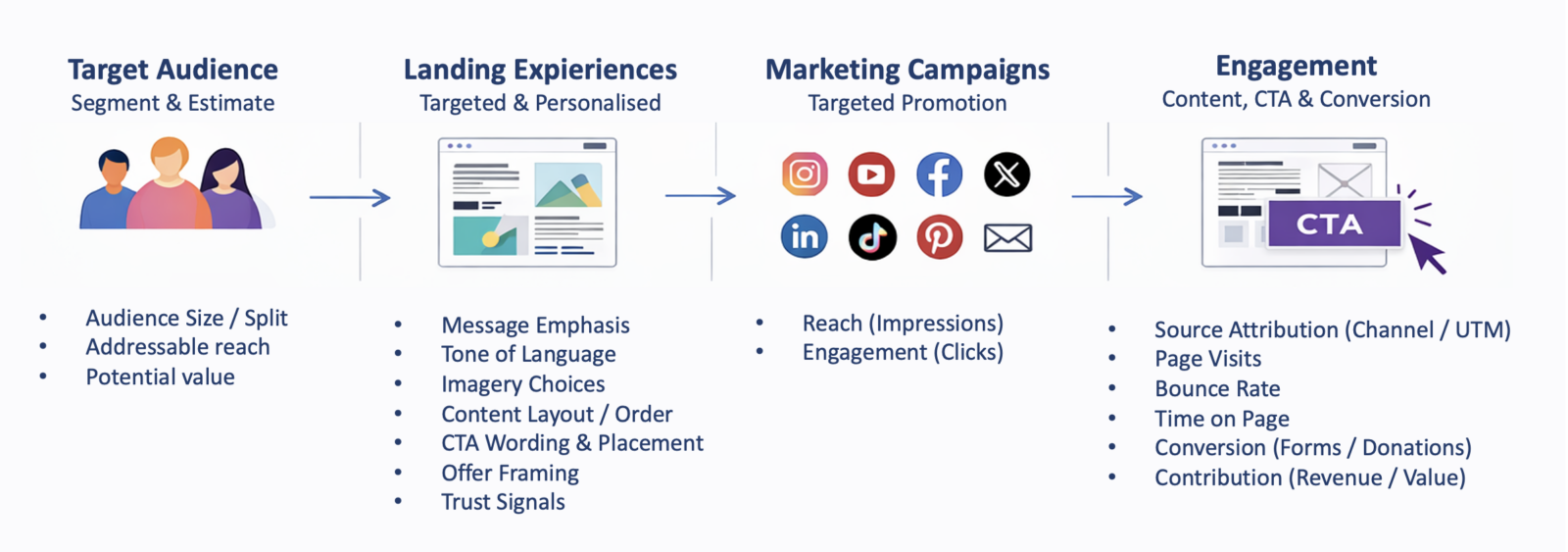
Next, create an experience that provides something valuable for that audience. This might be an article, event, service, resource, donation opportunity or digital interaction. The important consideration is that the experience serves a genuine audience need and provides an appropriate next step. By focusing on the experience before the promotion, we make sure there is something worthwhile for people to engage with when they arrive.
Once the experience exists, promote the experience through the channels most appropriate for the audience. Depending on the archetype, interest and lifecycle stage, that might involve search, social media, email, partners or other communication channels. Different audiences may respond to different promotional approaches, even when the underlying experience is the same.
Finally, measure performance, recognising that attracting people to an experience and providing a valuable experience are two different objectives. Measuring them independently is essential if we want to understand what worked, what didn’t and where improvement is needed.
Promotion performance and experience performance are different
A campaign can do an excellent job attracting the intended audience to an experience that doesn’t work particularly well. Equally, an excellent experience may receive little engagement because the promotion failed to reach the right people or give them a compelling reason to participate.
If we measure only the final conversion or outcome, these situations can appear to be the same problem. A disappointing result might lead a team to change its advertising, messaging or audience targeting when the real issue is the experience itself. Alternatively, teams may invest in redesigning an experience that already works well, when the real opportunity is to improve how people discover it.
Separating promotion performance from experience performance makes these decisions clearer. Promotion measurement helps us understand whether we reached the intended audience and encouraged them to visit or participate. Experience measurement helps us understand whether the people who arrived were able to achieve the intended outcome.
These measures serve different purposes and often point to different improvements. Together, they provide a more useful picture of digital engagement than a single campaign result, and they make ongoing optimisation more deliberate and effective.
An approach that works beyond the website
Know Your Audience isn’t exclusively a website design methodology. It’s a shared approach to digital engagement that can inform content architecture, marketing strategy, CRM segmentation, personalised communications, service design and continuous improvement.
For website projects, the model helps establish which experiences matter most, how information should be organised and where visitors need greater clarity or guidance. It encourages us to build navigation and content structures around audience needs rather than internal departments or the organisation’s existing collection of content.
For marketing teams, it provides a repeatable way to choose audiences, identify relevant experiences and select appropriate promotional channels. Rather than starting each campaign from scratch, teams can use a consistent understanding of audience combinations and lifecycle stages to guide their planning and evaluate performance.
For CRM and marketing automation, the model provides a foundation for meaningful segmentation without requiring an ever-growing collection of individual audience profiles, mailing lists and journeys. Rather than maintaining a separate list for every audience, interest and campaign, organisations can use structured information to identify relevant audiences when needed. Understanding someone’s interests helps determine what might be relevant to them, while consent and communication preferences determine how we can appropriately engage them.
This becomes particularly valuable as organisations adopt more capable marketing platforms. Dynamic segmentation, personalised experiences and automated journeys can build on a simple, consistent understanding of audiences rather than introducing additional complexity. We explore this application further in The Future of Marketing Is Here, using Salesforce Marketing Cloud Next as an example of how technology can support an audience-led engagement approach.
Perhaps most importantly, the model gives an organisation a shared language for discussing engagement. Website teams, marketers, service owners and leadership can use the same framework to understand who they’re trying to reach, which experiences matter and where investment should be prioritised.
As the organisation learns more about its audiences, the archetypes, interests and engagement priorities can be reviewed and refined. The framework itself remains consistent, allowing the organisation to improve its understanding without continually reinventing its approach.
Make audience understanding a business practice
Digital engagement is not something an organisation designs once and then considers complete. Audiences change, interests evolve, relationships develop and the experiences people expect continue to change. A sustainable digital system needs an equally sustainable approach to understanding the people it serves.
Our Know Your Audience methodology is designed to make that understanding practical. Beginning with a simple discovery conversation, we identify three or four archetypes, three or four interests and an engagement lifecycle that together provide a manageable foundation for decision-making. Combined with a repeatable process for choosing audiences, creating experiences, promoting them and measuring performance, the model becomes something teams can use every day rather than something they revisit only during a major project.
This simplicity isn’t based on the assumption that audiences themselves are simple. It’s a recognition that the frameworks we use to understand and engage people must be manageable if they’re going to remain useful over time. The objective is not to capture every possible variation, but to make better decisions consistently and improve those decisions as we learn.
The measure of a good audience model isn’t how many characteristics it can describe. It’s whether people actually use it to make better decisions.
Before deciding what content to create, which channels to use or what technology to implement, start by understanding who you’re trying to engage, what matters to them and where they are in their relationship with you. From there, designing meaningful experiences and improving their performance becomes a far more deliberate, repeatable and sustainable practice.
From Reactive Support to Proactive Managed Services
What does it really mean to move to a Managed Services model built around strategy, continuous improvement and predictable releases?
Managed Services is often described as proactive. The promise is that your technology partner will do more than respond to problems, helping your organisation improve its systems, introduce new capabilities and make better use of its technology investments. Yet for many organisations, the experience is surprisingly reactive. A request is submitted, a ticket is created, someone is assigned, and eventually the work is completed. There may be a monthly allocation of hours, a service level agreement and regular reporting, but the underlying relationship is still driven by whatever happens to arrive in the support queue.
This isn’t necessarily a failure of service. The provider may be meeting its obligations, resolving incidents and delivering requested changes. The challenge is that responding effectively to today’s needs isn’t the same as preparing for tomorrow’s opportunities. Business systems such as Salesforce, fundraising platforms, marketing automation and their supporting integrations are constantly evolving, and organisations need more than a reliable way to resolve issues. They need a way to ensure those systems continue to support their changing needs.
At AlphaSys, we believe genuinely proactive Managed Services requires a different operating model. One that brings business strategy, product ownership, planned improvements and regular releases into a predictable rhythm, allowing organisations to continually evolve the systems they depend on.
When Managed Services becomes a queue of requests
Business platforms rarely stand still. Salesforce environments evolve as organisations change their processes, introduce services, respond to regulatory requirements and discover new ways to engage with customers, members, donors and stakeholders. Over time, this creates a mixture of immediate support needs, operational maintenance, technical debt and opportunities for improvement. Without a deliberate approach to managing these competing demands, urgent requests tend to attract attention while important but less urgent improvements remain in the backlog.
In many traditional arrangements, the organisation remains responsible for identifying what needs to change, deciding what to request and repeatedly pushing work forward. The Managed Services provider responds when asked, but may have little involvement in shaping priorities or anticipating what comes next. This can leave organisations with a functioning platform that is becoming increasingly difficult to improve. Technology continues to consume budget, but the connection between that investment and meaningful business progress becomes harder to see.
A proactive relationship changes the conversation. Rather than beginning with a list of outstanding tickets, the organisation and its Managed Services partner begin by understanding what the business is trying to achieve, where existing systems are creating friction and which improvements will make the greatest difference.
Start with business direction, not the backlog
Moving to proactive Managed Services begins with understanding where the organisation wants to go and how its existing systems can help it get there. For an organisation using Salesforce, that might involve improving the way relationships are managed, simplifying administrative processes, strengthening reporting or creating better experiences for members and supporters. Other priorities may involve integrations, evolving marketing capabilities, fundraising processes or improving the reliability and maintainability of existing solutions. The important distinction is that these opportunities are considered in the context of business outcomes, rather than treated as isolated requests for technical work.
This requires an active partnership between the organisation’s Product Owner and its Managed Services team. The Product Owner brings knowledge of the business, its people and priorities, while the Managed Services partner contributes technical expertise, solution knowledge and an understanding of what is possible. Together, they balance immediate requirements with longer-term direction, ensuring the organisation’s investment is directed toward the improvements that matter most. Establishing the role of the Product Owner is therefore an important part of creating a more effective Managed Services relationship.
The objective isn’t to produce an ambitious roadmap that becomes outdated within months. It’s to establish a shared understanding of direction, supported by regular conversations that allow priorities to evolve as the organisation learns, grows and responds to change.
Create a rhythm of continuous improvement
Strategy alone doesn’t make Managed Services proactive. Without a reliable mechanism for translating priorities into delivered improvements, even the best roadmap can become another document that is rarely revisited. The real change happens when strategic direction is connected to a repeatable cycle of planning, delivery and release, providing the organisation with both visibility and confidence that improvements are steadily progressing.
Our approach is to establish connected operating cycles that turn business direction into regular, measurable progress. Annual and quarterly conversations provide opportunities to consider broader objectives, emerging needs and the future direction of the platform. Monthly planning translates those priorities into a realistic program of enhancements, taking account of available capacity, dependencies and operational responsibilities. Weekly engagement between the Product Owner and Managed Services team maintains momentum, allowing decisions to be made, requirements clarified and upcoming work prepared before it becomes urgent.
These conversations serve different purposes but operate as part of one continuous relationship. Business stakeholders understand when priorities will be considered, delivery teams have greater clarity about upcoming work, and the organisation can see how its systems are progressively evolving. Establishing a good Managed Services Product Owner cadence helps create the structure required to keep everyone aligned without introducing unnecessary meetings or administrative overhead.
Importantly, this rhythm also changes how available capacity is used. Rather than waiting for individual requests to arrive, the team can anticipate upcoming requirements, prepare work in advance and make informed decisions about what can realistically be achieved. Improvement becomes a planned and ongoing activity, rather than something that happens only when the support queue is quiet.
Make releases part of the operating model
One of the most important differences between reactive and proactive Managed Services is how improvements move from an idea into a working business capability. In a reactive arrangement, enhancements are often developed individually and released whenever they are ready, when someone has capacity or when a business stakeholder requests deployment. This can create unnecessary interruptions, inconsistent testing and uncertainty about when new capabilities will become available. A proactive model establishes a regular release rhythm, bringing greater discipline to development, testing, assurance and adoption.
At AlphaSys, we organise planned improvement around three connected activities: preparing the next cycle of work, delivering the current cycle and releasing completed improvements into the business. These activities operate together, allowing the team to look ahead while continuing to deliver. Upcoming enhancements can be clarified and prioritised without interrupting work already underway, while completed changes move through a controlled process of testing, release preparation and adoption.
For the organisation, the benefit isn’t simply more frequent releases. It’s knowing when improvements are expected, having confidence in how changes are introduced and being better prepared to help users adopt new capabilities. This approach also supports the broader objective of building a sustainable digital system, where the technology can continue to evolve without every improvement becoming another standalone project.
Not every improvement needs to wait for a scheduled release, and urgent fixes must still be addressed promptly. The value comes from establishing a dependable delivery pattern that accommodates operational realities while maintaining progress toward longer-term business objectives.
Balance proactive improvement with responsive support
Business systems are operational assets, and when something stops working, the organisation needs assistance quickly. A genuinely proactive Managed Services model must therefore maintain a dependable support function alongside planned improvement. Incidents, faults and urgent requests still require appropriate service levels, clear escalation pathways and people who can respond when needed. Moving toward a proactive relationship doesn’t mean reducing the importance of these responsibilities; it means ensuring they don’t consume the entire relationship.
Planned enhancements, operational assurance and strategic advice have their own place in the service, with capacity and responsibilities considered as part of the operating model. This creates a healthier balance between maintaining today’s operations and developing tomorrow’s capabilities. It also provides opportunities to identify recurring issues, address underlying causes and improve the reliability of the environment rather than repeatedly resolving the same symptoms.
The result is a service that can respond when something goes wrong while continuing to make progress when everything is working as expected. Both capabilities are important, and neither should come at the expense of the other.
What does moving to proactive Managed Services look like?
For organisations considering a change of Managed Services partner, transitioning an established Salesforce environment or other business-critical platform can feel daunting. These systems often represent years of investment, configuration and accumulated knowledge. They may contain complex integrations, custom development, undocumented processes and work already underway. The objective isn’t to start again, but to establish a stronger operating relationship around what already exists while maintaining continuity for the people who depend on it.
The transition begins by developing an understanding of the existing environment, its dependencies, support arrangements, current commitments and immediate risks. This creates the foundation for taking responsibility for the platform without unnecessarily disrupting normal operations. It also provides an opportunity to identify where knowledge is concentrated, where documentation may be incomplete and which areas need particular attention as the new relationship develops.
With that foundation established, the focus shifts toward understanding the organisation’s priorities, identifying the Product Owner and developing a shared view of the existing backlog. Rather than simply transferring a collection of outstanding tickets from one provider to another, requests can be considered in the context of business value, technical dependencies and available capacity. This helps distinguish immediate operational needs from improvements that should be planned, and creates an opportunity to bring previously disconnected activities into one coordinated approach.
The planning, delivery and release rhythms can then be introduced progressively. Early cycles may focus on smaller, well-understood improvements while the team develops deeper platform knowledge and confidence in the process. As the relationship matures, the focus can expand toward broader strategic opportunities, more complex enhancements and longer-term platform evolution. Importantly, becoming proactive doesn’t require the organisation to have a fully developed roadmap before getting started. Building and maintaining that direction is part of the ongoing partnership.
Measuring progress beyond tickets and hours
Traditional Managed Services reporting often focuses on operational measures such as tickets opened and closed, response times, hours consumed and compliance with service levels. These measures remain valuable, particularly when assessing service reliability, but they tell only part of the story. A service can perform well against every one of these measures while making relatively little contribution to improving the organisation’s underlying systems or capabilities.
A proactive relationship should also consider the improvements being delivered, the predictability of those improvements and the value they create for the business. Are processes becoming simpler and more reliable? Are users better supported by the platforms they rely on? Is technical debt being addressed? Are new capabilities reaching the organisation in a controlled and timely way? And is the business making more informed decisions about where to invest next?
These questions shift the focus from measuring activity to understanding progress. They encourage the organisation and its Managed Services partner to regularly consider not only what has been completed, but whether the work is contributing to the outcomes that matter.
Moving from support to partnership
The transition to proactive Managed Services is ultimately less about changing providers and more about changing how an organisation approaches the ongoing development of its technology. A good support provider helps keep systems working, but a proactive Managed Services partner helps ensure those systems continue to work for the organisation as its needs change. That requires more than technical expertise or a commitment to continuous improvement. It requires shared ownership, deliberate planning, dependable delivery and a consistent connection between business priorities and released capabilities.
At AlphaSys, our Managed Services model is designed around this principle, bringing people, strategy and technology together through repeatable, predictable and rhythmic delivery. By establishing regular planning conversations, maintaining a balanced program of support and enhancement, and introducing a dependable release cadence, we help organisations move beyond simply maintaining their technology investments toward continually improving them.
Because the real value of Managed Services isn’t just knowing someone will respond when something goes wrong. It’s having the confidence that your organisation’s systems are being actively managed, thoughtfully improved and consistently developed to support what comes next.
Online Sustainability by Design
Building resilient, engaging digital systems designed to last
At AlphaSys, we believe in building sustainable digital systems for social good. We believe the technology organisations invest in should continue delivering value long after the initial project is complete, adapting to changing needs rather than becoming another website destined for replacement.
Too often, websites are treated as disposable assets. They’re designed, built, launched and eventually replaced. Over time, content becomes harder to manage, functionality becomes more complicated and changes that should be straightforward require increasing effort. Eventually, the organisation faces another significant investment simply to regain the flexibility it once had.
We believe there’s a better way. Rather than designing websites primarily for launch, we design digital systems for the long term. Systems that remain dependable, engage the people they’re intended to serve and accommodate change without continually starting again.
We call this Sustainability by Design, an approach built around three complementary dimensions: Resilience, Engagement and Longevity.
Three dimensions of online sustainability
Each dimension addresses a different requirement of a sustainable digital system. Resilience ensures people can depend on it, Engagement ensures it delivers meaningful experiences, and Longevity ensures the investment can continue evolving as needs change.
These dimensions are closely connected. An engaging website that regularly fails undermines trust, while a resilient website that people cannot find or use provides limited value. Without longevity, both qualities become increasingly difficult and expensive to maintain.
Resilience — Can people depend on it?
For many organisations, their website is the primary connection between the services they provide and the people who need them. This is particularly important for organisations delivering social good, where digital experiences support access to essential information, community programs, fundraising, support services and other mission-critical activities.
Resilience is therefore about more than website uptime. It includes security, performance, scalability, protection against malicious activity and the ability to recover from disruption. It also requires understanding the dependencies that support the complete experience, including integrations, communications, payments and other services that may operate outside the website itself.
A website can be technically online while important functions have stopped working. An enquiry form might accept submissions without delivering them, an integration might fail to transfer information, or legitimate search engine crawlers might be prevented from accessing content. In each case, the infrastructure may appear operational while the organisation’s ability to engage its audiences has been compromised.
Designing for resilience means considering these dependencies from the beginning, choosing appropriate technology, understanding the risks and establishing practical ways to respond when something goes wrong. The objective isn’t to eliminate every possible failure, but to reduce avoidable disruption and maintain confidence in the services people depend upon.
Engagement — Does it meet audience needs?
A dependable website is only valuable when it successfully connects people with what they need. At AlphaSys, our approach begins with a simple principle: Know your audience. Design for audiences, not content.
Websites are often organised around what an organisation wants to publish, reflecting internal departments, programs and administrative structures. While the information may be accurate and comprehensive, that doesn’t necessarily make it easy for someone to find, understand or act upon.
We start by understanding the audiences an organisation serves, their interests, motivations and the different stages of their relationship with the organisation. This understanding informs how information is structured, how navigation works, what content is presented and which actions are made available. The objective is to create experiences that respond to audience needs rather than expecting audiences to understand the organisation’s internal structure.
Engagement also extends beyond the website itself. People need to discover an organisation before they can engage with it, making search engine optimisation, AI-powered discovery and other pathways into the website important considerations. Accessibility, usability and performance then influence whether visitors can successfully complete the journey.
As we explore in Beyond SEO: How to Make Your Website a Source AI Trusts and Cites, the way people discover information is evolving. Websites increasingly need to provide structured, credible and accessible knowledge that can support both human experiences and AI-driven discovery. The challenge is to accommodate these changes without compromising the experience designed for people.
Ultimately, engagement is measured by whether audiences can achieve meaningful outcomes. A website may attract considerable traffic, but if visitors struggle to find information, complete transactions or access services, that traffic alone doesn’t represent success.
Longevity — Can it evolve over time?
Organisations change. They introduce new services, respond to emerging needs, refresh their brands and adopt new technologies. A sustainable digital system should make these changes easier to accommodate rather than allowing them to become reasons for another website replacement.
Longevity begins with deliberate decisions about content, presentation and functionality. Content should be organised into meaningful, reusable collections with relationships that allow information to be maintained independently of where it appears. Presentation should use flexible design systems and reusable components, while functionality should be understandable, maintainable and developed with an emphasis on reducing unnecessary technical debt.
These decisions matter for both front-end and back-end users. A website might provide an excellent public experience while being unnecessarily difficult for the organisation’s own team to manage. If content authors struggle to update information, administrators depend on developers for routine changes or new requirements repeatedly introduce bespoke functionality, the system becomes progressively less sustainable.
Our article, From Website Replacement to a Sustainable Digital System, explores how we approach this in practice. Rather than treating the finished website as the primary deliverable, we establish the audience understanding, content architecture, design systems and reusable patterns that allow the website to evolve.
This approach also requires understanding the role each technology plays within the wider organisational ecosystem. Websites, CRM platforms, marketing systems and integration services have different responsibilities, and deliberate boundaries between them help prevent unnecessary duplication and complexity. We explore these considerations further in our article What Role Do Your Systems Play?
Longevity doesn’t mean building something that never changes. It means designing a system where change is expected, supported and progressively delivered, protecting the value of the original investment while allowing the organisation to move forward.
Considered technology choices make sustainability achievable
A sustainable digital system doesn’t require us to build or manage every component ourselves. In fact, some of the most important architectural decisions involve recognising where mature, specialised platforms can provide capabilities more effectively than developing or operating them independently.
Hosting, networking, DNS, content delivery and application security are complex technical disciplines. Delivering these capabilities directly requires specialised expertise, infrastructure investment and ongoing attention to emerging technologies and threats. For a digital agency, attempting to become an expert in every underlying discipline can introduce unnecessary operational complexity and divert attention from the experiences we’re ultimately trying to create.
At AlphaSys, we believe our responsibility is to understand what a digital system needs, make informed architectural choices and bring the right capabilities together. We need sufficient technical understanding to configure, integrate and manage those services appropriately, but we don’t need to build the underlying infrastructure ourselves.
This is why WP Engine and Cloudflare have been considered components of our default WordPress architecture. Both provide sophisticated infrastructure capabilities through services that are accessible, manageable and repeatable across our client environments.
WP Engine — Simplifying the WordPress foundation
WP Engine provides a managed hosting environment designed specifically for WordPress. Its platform simplifies many of the operational requirements associated with running websites, including hosting infrastructure, performance, backups and platform-level security.
For AlphaSys, this provides a consistent foundation across our WordPress portfolio. Rather than designing bespoke hosting arrangements for every client, we can work with established infrastructure and management capabilities while concentrating on the content, presentation, functionality and integrations that make each digital system valuable.
The benefits extend beyond operational convenience. Consistent environments are easier to understand, support and maintain, reducing unnecessary variation and allowing improvements in our approach to be applied across multiple client systems.
Cloudflare — Making sophisticated protection accessible
Cloudflare complements this foundation with capabilities spanning DNS, content delivery, application security, traffic management and bot protection. These services help us manage how websites respond to legitimate visitors, automated crawlers and potentially harmful traffic, while supporting performance and availability.
Many of these capabilities would traditionally require specialised networking and security expertise to establish and maintain. Cloudflare makes them accessible through managed services and configuration tools, allowing us to introduce appropriate protection without operating the underlying global network infrastructure.
This is particularly valuable as automated traffic becomes more sophisticated. Search engine crawlers, AI agents, malicious bots and legitimate users can all interact with the same website, sometimes competing for the same resources. Managing that traffic requires considered decisions about what should be allowed, restricted or protected, rather than simply blocking everything that appears automated.
Cloudflare gives us practical capabilities to make those decisions, while WP Engine provides the hosting foundation on which the WordPress application operates.
AlphaSys — Bringing the system together
Our role is to bring these capabilities together within a deliberate architecture that supports the organisation’s needs. WP Engine and Cloudflare provide specialised infrastructure services, while AlphaSys focuses on the audience experience, content and presentation systems, application functionality, integrations and ongoing evolution of the complete solution.
This doesn’t remove our responsibility for understanding the technology. We still need to make appropriate configuration decisions, understand service dependencies, recognise limitations and manage the operational responsibilities that remain ours. What it does remove is the need to recreate sophisticated infrastructure capabilities that established technology partners already provide.
We don’t need to be experts in everything. We need to be experts in making the right decisions.
That principle is central to our approach to sustainability. Choosing mature, manageable platforms reduces unnecessary complexity and allows more of our investment and expertise to be directed towards the outcomes that matter to our clients.
When resilience protects engagement
One of the clearest examples of the relationship between infrastructure and audience outcomes is website discoverability.
Organisations invest significant effort in creating content, establishing search authority and making their information accessible through search engines. Increasingly, they must also consider how AI-powered discovery services access and interpret that information. These investments are important because they connect people with the services, knowledge and opportunities an organisation provides.
However, discoverability also depends on the infrastructure delivering the content. Excessive automated traffic can consume server resources and affect performance, while incorrectly configured security controls can prevent legitimate crawlers from accessing important information. These conditions may contribute to crawling and indexing problems, degraded user experiences and reduced search visibility.
This creates an interesting relationship between protection and accessibility. We need to protect websites from harmful or excessive automated activity without unnecessarily restricting the legitimate systems that help audiences discover them. Effective bot management is therefore not simply a security decision; it can also influence engagement.
The same principle applies more broadly. A website that becomes unavailable during a major fundraising campaign, struggles under unexpected demand or experiences failures in essential integrations may lose valuable opportunities to engage its audience. Infrastructure resilience protects the digital pathways through which those interactions occur.
This is why we consider resilience, engagement and longevity together. The technical foundation must protect the experience, the experience must deliver value, and the architecture must accommodate the changes that will inevitably come.
Sustainability continues beyond launch
Deliberate design establishes the foundation for online sustainability, but the work doesn’t finish when a website goes live. Technologies change, new vulnerabilities emerge, audience expectations evolve and organisations continually identify opportunities to improve their digital experiences.
Without an ongoing approach to managing these changes, even a well-designed system can gradually accumulate technical debt and become less effective. Maintenance may keep the technology operational, but maintaining the status quo isn’t necessarily the same as keeping the system aligned with the organisation’s changing needs.
This is where Managed Services becomes an important part of our sustainability approach. By combining responsive support with planned enhancements, proactive assurance and regular strategic conversations, we can progressively improve digital systems rather than allowing change to accumulate until another major project becomes necessary.
In From Reactive Support to Proactive Managed Services, we explain how a predictable rhythm of planning, delivery and release helps organisations move beyond simply responding to problems. It creates an ongoing relationship in which technology investments are actively developed to support changing business priorities.
For online systems, this means regularly considering whether the platform remains secure and reliable, whether audiences are achieving their intended outcomes and whether the architecture continues to support efficient change. Not every improvement needs to be significant, but together they help protect the value of the system over time.
The goal is to move away from periodically purchasing replacement websites and towards continuously improving a valuable digital asset.
Building sustainable digital systems for social good
For organisations delivering social good, digital systems are increasingly central to how they fulfil their mission. They connect people with services, enable communities to engage, support fundraising and provide access to information that can make a meaningful difference.
We believe these systems deserve to be designed for more than their initial launch. They should be dependable when circumstances change, effective in meeting audience needs and flexible enough to accommodate the future without repeatedly starting again.
Online Sustainability by Design brings these considerations together through Resilience, Engagement and Longevity. It influences how we understand audiences, structure information, design experiences, select technology partners and continuously improve the systems we deliver.
Our considered use of WP Engine and Cloudflare is one practical expression of that philosophy. By making sophisticated infrastructure capabilities accessible and manageable, these partners help us establish dependable foundations while focusing our expertise on delivering meaningful digital experiences.
Ultimately, sustainability isn’t defined simply by how long a website remains online. It’s defined by how effectively the system continues serving its purpose, supporting its audiences and adapting to what comes next.
Resilience. Engagement. Longevity. Three dimensions of Online Sustainability. All by design.
AlphaSys — Building sustainable digital systems for social good.
Beyond SEO: How to Make Your Website a Source AI Trusts and Cites
For more than two decades, organisations have invested in Search Engine Optimisation to help their websites appear when people search for information. The goal was relatively clear: rank well, attract visitors and convert some of those visitors into customers, donors, members, clients or supporters.
Artificial intelligence is changing that journey.
Increasingly, people are not beginning with a list of search results. They are asking ChatGPT, Microsoft Copilot, Google Gemini and other AI assistants to explain a subject, compare options, recommend an approach or help them make a decision. Instead of visiting ten websites and piecing together the answer themselves, they may receive one generated response built from information gathered across multiple sources.
This is creating understandable pressure for organisations. Nobody wants to be left behind while AI reshapes how people discover information, form opinions and choose who to trust. Many organisations are now trying to understand what they should change, what they should invest in and whether their existing website is ready for this new environment.
The strategic question is becoming:
When AI answers questions in your area of expertise, will your organisation be one of the sources it trusts and cites?
This is not simply a marketing or technology question. It affects visibility, reputation, authority and future customer acquisition. Organisations that become reliable sources may be introduced to audiences before those audiences ever visit a search engine, see an advertisement or speak with a sales team. Organisations that are not included may gradually become less visible, even if their traditional search rankings remain reasonable.
The challenge is not to redesign websites for machines. It is to make the organisation’s knowledge clear, credible and accessible without damaging the experience created for people.
From being found to being relied upon
Traditional SEO is primarily concerned with helping a page appear in search results. AI citation introduces a different objective. The website must contain information that an AI system can understand, extract, verify and confidently use as part of an answer.
A search engine may rank a page because it appears relevant to a phrase. An AI system also needs to determine whether the content is reliable enough to support a statement. It may look for clear answers, recognised expertise, current information, visible evidence and consistency across the wider web.
The opportunity is therefore larger than improving rankings. The goal is to establish the organisation as a dependable source of knowledge in the areas where it has genuine authority.
For a health organisation, that may mean becoming the source AI cites when people ask how to manage a condition. For a professional services firm, it may mean providing the clearest explanation of a complicated business or regulatory issue. For a charity, it may mean becoming the trusted source for facts about a cause, an affected community or an appropriate response. For an industry body, it may mean maintaining the definitions, standards, benchmarks and guidance that others rely upon.
This is the beginning of a shift from publishing webpages to managing organisational knowledge.
The temptation to chase the AI race
The rapid adoption of AI is creating a familiar kind of urgency. Organisations know something important is changing, but the practical response is not always clear. Some are experimenting with chatbots. Some are publishing more articles. Some are renaming existing SEO activity as generative search optimisation. Others are waiting for the technology to settle before making any significant decisions.
The problem is that activity alone does not create authority.
Publishing a larger volume of generic content will not necessarily make an organisation more visible in AI-generated answers. Adding an AI chatbot to a website does not make the content behind it more trustworthy. Installing a plugin or adding new technical markup does not compensate for vague, outdated or unsupported information.
A stronger response begins with structure.
The organisation needs to identify what it knows, what it can credibly claim, which questions it should be able to answer and how that knowledge should be maintained over time. This creates a practical path forward without requiring the organisation to predict which AI platform will dominate or how every feature will evolve.
Three approaches to AI citation
There are three broad ways organisations can respond. Each has value, but they lead to different outcomes.
1. Create dedicated knowledge content
The first approach is to introduce content types that are naturally suited to answering questions and explaining important subjects. These might include Frequently Asked Questions, factsheets and guides. Each content type performs a different role.
- A FAQ provides a focused answer to one question. It should be clear, concise and useful without requiring the reader to understand a large amount of surrounding content.
- A factsheet provides a maintained reference. It may bring together definitions, key facts, important figures, requirements, risks, responsibilities or other information that needs to remain accurate over time.
- A guide explains how to understand, plan for or act on a subject. It provides context, examples, practical recommendations and a pathway through a more complicated issue.
Together, these content types give the organisation a structured knowledge base rather than a collection of disconnected pages.
For example, a health organisation might publish a FAQ answering whether alcohol can worsen an allergic reaction, a factsheet explaining the key risks associated with food allergies at celebrations and a guide helping families plan safely for birthdays, Christmas, community events and travel.
A consulting firm might publish a FAQ explaining the difference between project management and program management, a factsheet defining responsibilities and governance, and a guide helping organisations decide which model is appropriate for a major transformation.
This approach gives AI systems clearer material to work with and gives people more direct paths to the information they need.
However, adding new content types is not enough on its own.
A website does not become authoritative simply because it has a section called “Factsheets”. A short, generic factsheet with no visible evidence, no accountable owner and no review process may be no more valuable than an ordinary webpage. The organisation still needs to demonstrate expertise, maintain accuracy, show when information was reviewed and explain the basis for important claims.
Dedicated content types provide the foundation. They do not automatically create trust or guarantee citation.
2. Optimise whole pages for citation
The second approach is to redesign individual pages around a citation-readiness model.
A highly citation-ready page may contain a direct answer near the beginning, clear headings based on common questions, short self-contained sections, visible authorship or expert review, references, publication dates and plain-language definitions.
These characteristics make information easier for AI systems to retrieve and quote. They also make important claims easier for people to verify.
This can be a useful way to assess content quality. It helps identify pages that are vague, outdated, unsupported or difficult to understand. It can also expose a common weakness in corporate websites: they often make broad claims without providing enough useful information to substantiate them.
For example, a service page may say:
We provide innovative solutions tailored to your organisation.
That statement may sound acceptable in marketing copy, but it has little informational value. It does not explain what the organisation does, how its approach works, when the service is appropriate or why someone should trust it. A stronger page may explain the service model, the circumstances in which it is useful, the risks it addresses, the outcomes it is intended to create and the experience behind the recommendation.
The risk is that citation optimisation can be taken too far.
If every page is forced to begin with a formal answer, follow the same rigid structure and present information as a series of isolated statements, the website may become less engaging for people. Health content may lose empathy. Fundraising content may lose emotion. Thought leadership may lose its argument. Service pages may become dry reference documents rather than persuasive experiences.
A person may need reassurance before detail. They may benefit from a story, an example or an explanation that unfolds naturally. They may need to feel understood before they are ready to act.
The highest-scoring page for machine extraction is not automatically the best page for a human reader.
A citation-readiness model should therefore be used as a diagnostic tool, not as a universal design template. It can identify missing authority, evidence, clarity or currency, but it should not force every page to look and sound the same.
3. Keep the experience human and make the knowledge citation-ready
The strongest approach is to separate the human experience from the knowledge structure supporting it. This does not mean creating two different websites. It means recognising that a well-designed page and a well-structured source of knowledge are not always the same thing.
A page may be created to guide, reassure, persuade or inspire a person. It may use narrative, photography, examples, case studies and carefully paced information. At the same time, the site can contain related FAQs, factsheets, definitions, expert profiles and evidence that provide clear and authoritative answers.
Consider a guide for people managing food allergies during celebrations. The guide may begin empathetically, acknowledge the anxiety families can experience and walk through practical situations such as birthday parties, shared meals, barbecues and travel. That is appropriate human-centred communication.
The same site may also contain a related FAQ answering:
How can people with food allergies stay safe at celebrations?
It may include another FAQ explaining cross-contamination at a barbecue, a factsheet covering medication and emergency planning, and clinically reviewed information explaining whether alcohol may increase the severity of a reaction.
The human reader experiences one coherent and supportive guide. The AI system can identify and retrieve the specific answer most relevant to the question it has been asked.
The guide does not need to become mechanical. The knowledge does not need to remain buried inside a long page. This approach allows the organisation to improve its chances of citation without sacrificing tone, empathy, storytelling or conversion.
The website becomes a connected body of knowledge
This model works best when content is connected rather than repeatedly copied. Most websites are still built as collections of pages. Each page is commissioned separately, written separately and maintained separately. Definitions, claims and answers are copied from one area to another, often becoming inconsistent over time.
A more sustainable model treats each piece of knowledge as a reusable organisational asset.
Under this approach:
- a page creates an experience
- a FAQ answers a specific question
- a factsheet maintains key information
- a guide explains how to understand or act
- a case study demonstrates real-world experience
- a service page explains what the organisation provides
- an expert profile establishes who is accountable for the advice
- a source or reference supports an important claim
These pieces can be connected and surfaced together without duplicating the underlying information.
A factsheet may be linked to several guides. A FAQ may appear on a service page, within a campaign page and in a related-content panel while still being maintained as one authoritative answer. An expert profile may connect a person to every guide and factsheet they have reviewed.
This creates a stronger website for people because related information is easier to find. It also gives AI systems clearer signals about how subjects, experts, services and evidence fit together. The organisation is no longer merely publishing pages. It is maintaining an interconnected body of knowledge.
Why authority matters more than volume
Many organisations will respond to AI by producing more content. That is unlikely to be enough. AI systems do not need another generic article summarising information already available across hundreds of websites. The strongest opportunity is to publish information the organisation is genuinely qualified to own. This might include:
- original research
- first-party data
- sector benchmarks
- service outcomes
- expert interpretations
- maintained definitions
- practical methodologies
- regulatory guidance
- calculators and decision tools
- case studies with measurable results
- specialist answers based on substantial experience
An organisation is more likely to become a source if it publishes a credible annual industry benchmark than if it publishes another general article about industry trends. A charity may become authoritative by maintaining reliable facts about the community it serves. A consulting firm may become citable by clearly defining a delivery model it has developed and applied. A health organisation may become a trusted source by publishing clinically reviewed practical guidance that is kept current.
The key question is not:
How much content are we producing?
It is:
What knowledge does our organisation have a credible right to own?
That question provides a much stronger basis for action than simply joining the race to publish more.
Governance becomes essential
If the website is expected to become a trusted source, content governance can no longer be informal.
The organisation should understand which subjects it intends to be authoritative on, who is accountable for each area of knowledge, which content requires specialist review and how often important information must be reassessed. It should also be clear how outdated information is corrected or withdrawn, what evidence supports significant claims, how consistency is maintained across channels and how the organisation will determine whether its content is being used and cited.
This does not require a heavy approval process for every piece of communication. It requires a deliberate distinction between
- campaign content,
- general communication and
- maintained organisational knowledge.
A social post may be timely and short-lived. A factsheet about safety, regulation or service eligibility may need formal ownership and a review schedule. A guide representing the organisation’s methodology may need approval from a subject-matter expert or accountable leader.
Without governance, a larger content library may simply create more inconsistency.
A practical framework for action
A balanced AI citation strategy can be built around three layers.
1. Knowledge foundations
Create and maintain dedicated content types such as FAQs, factsheets and guides. Connect them to relevant topics, audiences, services, experts, evidence and related content.
This gives the organisation a clear structure for deciding where different forms of knowledge belong and how they should support each other.
2. Citation-readiness assessment
Assess important pages and knowledge assets for clarity, authority, evidence, currency and accessibility.
This does not mean every page needs to achieve the same score or follow the same pattern. A guide, service page, campaign page and factsheet have different jobs. The assessment should identify likely barriers to citation while respecting the purpose of the content.
Over time, this can become a practical content-management capability. Just as SEO tools help editors understand whether a page is likely to perform well in search, an AI citation score could help them understand whether the content is clear, supported, current and structured in a way that makes citation more likely.
The score would not guarantee that an AI platform cites the page. No organisation can control that. It would provide a consistent way to improve the probability.
3. Human-centred delivery
Continue designing pages around the needs of real people. Use tone, narrative, examples, imagery and visual design appropriately, while drawing on the structured knowledge underneath.
This leads to a straightforward principle:
Human-first experiences, citation-ready knowledge.
Measuring success
Traditional measures such as traffic, search rankings and conversions will remain important. They should be expanded rather than replaced.
Organisations may also begin to measure whether their website is cited by major AI platforms, which knowledge assets are being referenced, what questions lead to citations and whether competitors are being cited more often.
They may also examine traffic arriving from AI-generated answers, the quality of those visitors, incorrect AI responses the organisation is well placed to correct and topics where it has genuine authority but lacks suitable content.
These measures will continue to evolve as the platforms improve their reporting. The strategic direction, however, is already clear: visibility will increasingly depend on whether an organisation is recognised as a reliable source, not only whether its pages rank well.
The next evolution of the website
SEO taught organisations to make pages discoverable.
– AI is encouraging organisations to make knowledge understandable, trustworthy and reusable.
That does not mean abandoning SEO, redesigning every page for machines or replacing good communication with formulaic answer blocks. It means treating the website as more than a marketing channel.
The website can become a maintained expression of what the organisation knows, what it has learned, what it can prove and what it is qualified to advise others about.
The organisations that benefit most will not necessarily be those that publish the greatest volume of content. They will be those that organise their expertise clearly, support it with evidence, maintain it responsibly and present it in a way that still works for people.
The next challenge is not simply to be found.
It is to become a source worth citing.
The Future of Marketing Is Here.
What Does Moving to Marketing Cloud Next Look Like?
Marketing technology is changing, and Salesforce Marketing Cloud Next presents an opportunity for organisations to rethink how they communicate with their audiences. With closer integration between marketing and CRM, more sophisticated audience segmentation, personalisation and automation, the platform promises to make marketing more connected, relevant and responsive.
For organisations already using Salesforce, the opportunity is particularly interesting. Much of the information needed to deliver more meaningful marketing experiences may already exist within CRM. The challenge is making that information available and useful to the marketing team, without creating an increasingly complicated collection of lists, segments, integrations and automated journeys.
But what does moving to Marketing Cloud Next actually involve? How much of your existing marketing operation needs to be rebuilt? Will you need to redesign your campaigns, retrain your team or reorganise your data? And how do you make the most of the new capabilities without turning a platform migration into an enormous transformation project?
At AlphaSys, our approach is to make the transition manageable while using it as an opportunity to improve the way your organisation engages with its audiences. Rather than simply recreating everything from your existing platform, we help you establish the core capabilities needed to operate Marketing Cloud Next effectively, then progressively build on those capabilities as your marketing requirements evolve.
Moving forward without starting again
Most organisations considering a migration already have an established marketing operation. They have email templates, mailing lists, automated journeys, consent arrangements and reporting processes that support their everyday activities. Some of these have been carefully designed, while others have developed organically as new campaigns, programs and requirements have emerged.
The first question is what should move across. It’s tempting to treat migration as a replication exercise, rebuilding every template, audience and journey exactly as it exists today. While this might appear to reduce change, it can also carry forward the limitations of the previous platform and miss opportunities to simplify the marketing operation.
We prefer to begin by understanding what you have and how it is being used. We review the existing marketing environment, including your templates, journeys, audience structures, brand assets and consent arrangements. We also look at the information already available within Salesforce and how it might support marketing activities in the new environment.
This doesn’t mean conducting an exhaustive audit of every campaign you’ve ever run. The objective is to understand the capabilities your team depends on, identify any important gaps and agree on what needs to be available when the new platform goes live. Some existing activities may be reproduced with relatively little change, while others present opportunities to take advantage of Marketing Cloud Next’s capabilities.
By establishing these priorities early, we can focus the migration on getting your marketing team operational without making the project dependent on rebuilding everything at once.
A better understanding of your audiences
One of the most valuable opportunities presented by Marketing Cloud Next is the ability to bring marketing activities closer to the audience information already held within Salesforce. Rather than maintaining separate lists and repeatedly preparing data for individual campaigns, marketing teams can begin working with audiences that reflect the organisation’s existing relationships and activities.
To make this useful, we spend time understanding how your organisation thinks about its audiences. Our Know Your Audience process considers three complementary dimensions: who people are, what interests them and where they are in their relationship with your organisation.
For example, an education organisation might engage with prospective students, current students, alumni and industry partners. These are different audience archetypes, each with different motivations and expectations. Within those groups, people may have interests in particular courses, disciplines, events or professional development opportunities. Their relationship with the organisation also changes over time, as someone moves from considering a course to applying, enrolling, graduating and eventually becoming an alumnus.
These distinctions help us establish a more useful approach to segmentation. Instead of creating a separate mailing list for every combination of audience, interest and activity, we can use structured information within Salesforce to identify the people relevant to a particular communication.
During the migration, we work with your team to establish an initial audience model and demonstrate how it can be used. This typically includes configuring a representative fixed audience, such as the recipients of a particular campaign, alongside a dynamic segment that updates as the underlying Salesforce information changes.
The intention isn’t to model every possible audience before going live. It’s to establish an approach your marketing team understands and can extend as new requirements emerge.
Making sense of preferences and consent

Audience segmentation is closely related to another important consideration: how people manage the communications they receive.
Many organisations have accumulated a collection of subscription lists, consent flags and preference fields over time. Some indicate whether someone has agreed to receive particular communications, while others describe their interests or relationships with the organisation. These are different concepts, but they are frequently managed together.
A migration provides an opportunity to clarify these arrangements. We review your existing consent information and preference centre, then work with you to establish a structure that supports both appropriate consent management and more meaningful audience preferences.
For example, someone might have consented to receive marketing communications but only be interested in particular programs or activities. By distinguishing their permission to receive communications from the topics that interest them, marketing teams can make more informed decisions about what to send.
Within Marketing Cloud Next, we establish the agreed preference centre and supporting tag structures. Where appropriate, existing fields can be transformed into tags, and processes that currently create those fields can be updated to support the new approach. Existing consent requirements and suppression rules remain important throughout this process.
This work helps avoid a common migration problem: carrying forward years of accumulated mailing lists and preference settings without reconsidering whether they still make sense. It also gives your organisation a more consistent way to introduce new interests, programs and communication opportunities in the future.
Establishing your marketing toolkit
While the audience work is progressing, we also establish the practical capabilities your marketing team needs to start using Marketing Cloud Next.
The technical setup includes configuring the environment, user access and permissions, sender settings and email authentication. We connect Marketing Cloud Next with Salesforce CRM and establish the foundational configuration needed to support the agreed marketing activities.
We then turn our attention to email creation. Most organisations already have established branding and a collection of templates, so the objective is not necessarily to redesign everything. Instead, we use your existing brand assets to establish reusable templates and components that make it easier to produce consistent communications.
This component-based approach allows marketing teams to assemble emails using established patterns rather than continually recreating layouts. It also provides a foundation for introducing personalisation, where different recipients can receive content relevant to their information or interests.
As part of the migration, we demonstrate standard personalisation capabilities, dynamic content variations and email experimentation. These allow your team to see how Marketing Cloud Next can support more sophisticated communications without needing to implement every possible variation immediately.
The emphasis is on establishing a practical toolkit that your marketing team can use independently, rather than delivering a collection of finished emails that require technical assistance whenever something needs to change.
Getting your first journey running
Automated marketing journeys are often among the most complicated parts of a migration. An established organisation may have numerous journeys supporting different audiences, campaigns and business processes, with varying levels of complexity.
Attempting to rebuild all of these simultaneously can make the migration unnecessarily difficult. Some may rely on data that isn’t yet available in Salesforce, while others may have been designed around limitations of the previous platform that no longer apply.
Our approach is to agree on a priority journey that can be established using information already available within Salesforce. This provides a practical opportunity to demonstrate how audience selection, communications, consent controls and reporting work together in Marketing Cloud Next.
For example, an organisation might choose a prospective student engagement journey. When someone meets an agreed set of criteria within Salesforce, they enter a sequence of communications designed to help them explore relevant study opportunities. The journey can use their available information to personalise communications, apply appropriate suppression rules and provide reporting on engagement.
The specific journey will depend on your organisation’s priorities. What matters is that it represents a genuine marketing requirement and establishes an approach that can be reused.
Once that first journey is working, your team has a practical reference for building others. Rather than learning the platform through abstract training exercises, they can see how the different capabilities come together in an activity relevant to their everyday work.
What happens during the migration?
For a focused initial Marketing Cloud Next implementation, our approach typically follows a ten-week program divided into five two-week stages. The intention is to provide enough structure for everyone to understand what is happening, while allowing the detailed configuration to respond to the priorities and complexity of your organisation.
Weeks 1–2: Getting ready and understanding your current environment. We begin with a project kick-off, confirm licensing and access, establish the delivery arrangements and review your existing marketing operation. This includes walking through your current templates, journeys and consent arrangements, as well as discussing the approach to preference management. We also prepare our initial thinking about your audiences, interests and lifecycle stages.
Weeks 3–4: Establishing the platform and designing your audience model. We configure the core Marketing Cloud Next environment, including users, permissions, sender settings and reusable brand assets. During this period, we also conduct the Know Your Audience workshop, where we work through the proposed audience archetypes, interests and lifecycle stages. These discussions inform the tag structure and preference centre proposal, which we review and agree with your team before configuration.
Weeks 5–6: Building the working marketing capabilities. With the foundational decisions made, we configure the agreed audience structures, preference centre and priority marketing journey. This includes establishing representative fixed and dynamic audiences, implementing the relevant tags and transformations, and connecting Marketing Cloud Next with Salesforce. Much of this work is undertaken by the delivery team, with questions and decisions managed through the agreed project process rather than requiring continuous workshops.
Weeks 7–8: Demonstrating the solution and enabling your team. We move into practical demonstrations and coaching, showing your marketing team how to create emails, manage audiences, work with journeys and interpret reporting. We also demonstrate personalisation, dynamic content and experimentation. This is an opportunity for your team to become familiar with the configured solution, ask questions and begin understanding how they will operate it after the migration.
Weeks 9–10: Testing and going live. The final stage focuses on testing, resolving defects, completing production checks and preparing for launch. We work through the agreed go-live arrangements, finalise operational documentation and support the transition into production use.
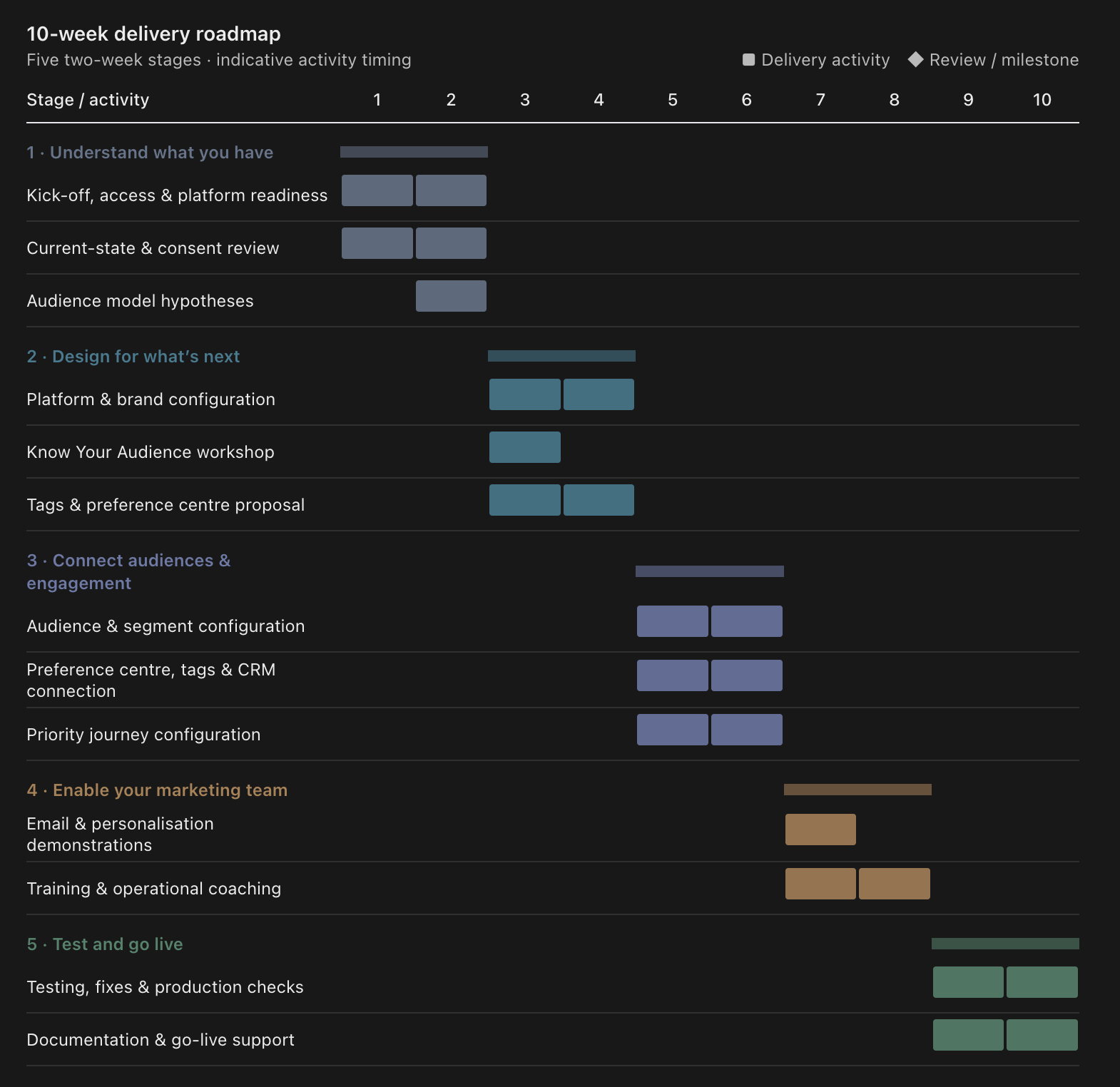
Throughout the project, we use an iterative delivery approach, progressively configuring and demonstrating the solution rather than waiting until the end to reveal a completed implementation. Your team participates in the key workshops, reviews the proposed structures, makes prioritisation decisions and becomes familiar with the platform as it takes shape.
The ten-week structure is intended for a focused migration. More extensive requirements, such as substantial data cleansing, additional integrations or rebuilding a large portfolio of complex journeys, may require further work and should be considered separately.
What will you have when the migration is complete?
By the end of the initial migration, the objective is to have a working Marketing Cloud Next environment that your marketing team can begin using, rather than simply a technically configured platform.
This includes the foundational platform configuration and Salesforce connection, reusable email creation capabilities, an agreed approach to audience segmentation and preference management, and at least one prioritised marketing journey, subject to the agreed delivery scope and capacity. Your team will also have been introduced to the platform’s personalisation, experimentation and reporting capabilities through practical demonstrations and coaching.
Just as importantly, you’ll have a clearer understanding of how your organisation can use Salesforce information to support marketing engagement. The audience archetypes, interest groups and lifecycle stages established during the migration provide a common framework for considering future campaigns and journeys.
Not everything needs to be completed during the initial project. You may still have historical journeys to migrate, additional audiences to configure, data quality improvements to undertake or more advanced personalisation opportunities to explore. These can be prioritised as subsequent activities rather than becoming prerequisites for the initial launch.
This is an important distinction. A successful migration doesn’t necessarily mean every historical capability has been reproduced. It means your organisation has the essential capabilities needed to operate the new platform, with a clear and practical path for extending them.
Where do you go from here?
Moving to Marketing Cloud Next is an opportunity to reconsider how marketing operates within your organisation, but it doesn’t need to become a wholesale reinvention of everything you do.
You can preserve the campaigns and communications that already work, simplify the audience structures that have become difficult to manage and progressively introduce more sophisticated segmentation, personalisation and automation.
As your marketing team becomes more familiar with the platform, new opportunities will emerge. You might introduce additional lifecycle journeys, use dynamic segments to make campaigns more responsive, experiment with different content for different audiences or develop more detailed reporting on engagement.
The audience understanding developed through the migration can also have value beyond email. The same archetypes, interests and lifecycle stages can inform website experiences, broader CRM activities and engagement across other channels, helping the organisation develop a more consistent approach to its relationships.
Ultimately, the aim is to make marketing less dependent on managing lists, preparing data and rebuilding individual communications, and more focused on understanding audiences and delivering relevant engagement.
The future of marketing is not simply a new platform. It’s a better way of connecting with the people who matter to your organisation.
At AlphaSys, we help organisations make that transition through a structured, practical Marketing Cloud Next migration that establishes the essential capabilities first, enables their teams and creates room for marketing to evolve.
From Website Replacement to a Sustainable Digital System
Many organisations we work with are not struggling because they cannot update their website. They are struggling because their website has become increasingly difficult to change.
The organisation has evolved since the site was built. Services and programs have changed, new audiences have emerged, priorities have shifted and the story the organisation wants to tell is no longer quite the story the website was designed to tell. Yet seemingly straightforward changes can become surprisingly difficult. There is nowhere obvious to put something new, navigation is already crowded, the same information exists across multiple pages, and changing one part of the story creates consequences somewhere else.
Eventually the website starts influencing the organisation rather than supporting it. Teams hesitate to restructure content, reconsider journeys or refresh the brand because they know that doing so may trigger significant design and development effort. The organisation can edit the website, but it cannot easily reframe it.
Much of this comes from how websites have traditionally been created. A familiar agency process is to define a sitemap, create wireframes, produce visual mock-ups, configure a CMS or page builder, populate the pages, test them and launch. There is nothing inherently wrong with that approach, and it can produce very good websites. Its limitation is that the website itself becomes the thing being designed and built. Content, navigation, presentation and technology become progressively intertwined around the experience required for that particular launch.
A sustainable digital project starts from a different objective. We still need to launch an excellent website, but we also want to establish a digital system capable of accommodating the organisation that website will need to become.
That changes the flow of the project:
Take Stock → Know Your Audience → Atomic Design → Content Modelling → Content Planning → Content Pooling → Experience Design → Site Building
The sequence progressively separates and then reconnects the things that traditional website projects often bind together: audiences, content, structure, presentation and experience. In practice the stages overlap and later learning will cause us to revisit earlier decisions, but there is still value in understanding the logical sequence and what each stage contributes.
And the bonus with this approach is that the early work extends well beyond the website. Take Stock and Know Your Audience are focused on digital engagement rather than simply web engagement, so the understanding we develop about audiences, interests and engagement life stages can also inform social engagement, direct email marketing, campaigns, CRM journeys and other digital channels. The website may be the immediate project, but the thinking behind it helps strengthen the organisation’s broader digital engagement.
1. Take Stock
The first step is to understand what already exists before deciding what the new website should become.
That means taking stock of the existing websites, content, navigation, technology, integrations, forms, search, analytics, SEO and security, as well as the broader digital environment around them. We want to understand what is working, what is creating friction, what has become difficult to maintain and where the existing environment is limiting the organisation.
Importantly, this is not simply an exercise in finding problems. An ageing website can still contain years of valuable organisational thinking, useful content, established stakeholder journeys and functionality that continues to serve its purpose. Replacing the technology does not mean everything built on it should automatically be replaced.
The content estate deserves particular attention. Over time, websites accumulate pages, duplicated information, outdated material and structures that made sense when they were created but may no longer reflect the organisation. Taking stock allows us to identify what should be retained, what can be rationalised or consolidated and what no longer needs to move forward.
We also need to understand the wider systems with which the website interacts. CRM, marketing platforms, payments, forms, identity, search and other services may all form part of the digital experience even though they sit outside the website itself. Understanding those dependencies early helps prevent the new site from simply recreating existing integration and operational problems on a newer platform.
The objective is not to redesign anything yet. It is to establish a reliable starting point: what we have, what remains valuable, what needs to change and what constraints or opportunities the existing environment creates. A sustainable digital project should rarely begin with a blank canvas. It should begin with a clear understanding of what is already there.
2. Know Your Audience
Once we understand the existing digital estate, the next step is to understand the people the digital system needs to serve.
Rather than developing a large collection of traditional personas, we use a deliberately constrained three-dimensional audience model. It considers people across three dimensions: archetype, interest and engagement life stage.
Archetypes describe the broad type of relationship a person has with the organisation. Interests describe what they are interested in or trying to achieve. Engagement life stages recognise that the needs of someone discovering an organisation for the first time can be very different from those of someone already participating, supporting or maintaining a long-term relationship.
We deliberately keep each dimension small, typically to three or four meaningful categories. Archetype × Interest creates our engagement matrix, giving us a manageable set of audience combinations rather than dozens of personas. Each cell in that matrix is then considered across the engagement life stages to understand how that audience’s needs, motivations, messages, calls to action and experiences may change as their relationship with the organisation develops.
The model gives the rest of the project a practical lens for decision-making. We can ask which archetypes a piece of content serves, which interests it addresses and at what engagement stage it becomes relevant. That thinking will later inform content modelling, navigation, journeys, search, personalisation and experience design.
The value of the model comes from keeping it usable. We want enough variation to expose genuinely different audience needs without creating so many audience definitions that every decision becomes an exercise in managing theoretical personas.
By the end of this stage, we have not designed the website. We have established a manageable model of who may be engaging with us, what they are interested in and where they are in their relationship with the organisation.
3. Atomic Design
With the existing environment understood and a practical audience model established, we can begin exploring how the organisation’s brand might translate into a contemporary digital experience.
We typically start with an exaggerated visual interpretation of a homepage. At this point, it is not intended to be the final homepage or even a page that will necessarily be built. It is a creative device that allows us to explore the digital expression of the brand more freely and make ideas tangible enough for stakeholders to respond to them.
The design deliberately pushes further than a conservative first draft might. It explores typography, colour, imagery, spacing, movement, hierarchy, calls to action, content treatments and interaction ideas together in one rich visual composition. This is often much easier for stakeholders to respond to than discussing individual design elements in isolation.
We then take that interpretation through a small number of feedback loops( usually two – its easy to find yourself in analysis paralysis here). The objective is not to perfect the homepage. It is to establish enough confidence in the visual direction to understand the design language that sits underneath it.
Once that direction has emerged, we explode the design into its atomic parts.
Typography, colours, spacing, buttons, cards, links, controls, imagery treatments and other foundational elements become atoms. Those combine into increasingly useful components and patterns such as cards, navigation elements, content treatments, calls to action and form elements. What began as a deliberately expressive visual concept starts becoming a structured and reusable Atomic Design system.
This is an important distinction from designing a homepage and then proceeding page by page through the rest of the website. The initial homepage exploration is being used to discover the system, not define the site.
Nor is the Atomic Design system considered finished at this point. It establishes the initial visual vocabulary and enough reusable structure for the next stages of the project. As real content and audience experiences are designed later, those atoms, components and patterns will be tested, refined, polished and extended.
By the end of this stage, we have moved from an expressive interpretation of what the digital brand could feel like to the beginnings of a reusable system that can consistently express that brand across the experiences we design next.
4. Content Modelling
By this point, we already know considerably more about the shape of the future digital system than we did at the beginning.
Taking stock has shown us what content exists, how the current site is structured, what performs well and where duplication or structural problems have accumulated. Knowing our audiences has given us a model for who needs that information, what they are interested in and how those needs change across their engagement life stages. Atomic Design has started making the future experience tangible and has helped expose the different ways information may need to be presented.
Together, those stages begin to shape three closely related things: the navigation systems, the SEO and discoverability framing, and the content model underneath them.
Content Modelling is where we bring that emerging understanding together and give it structure.
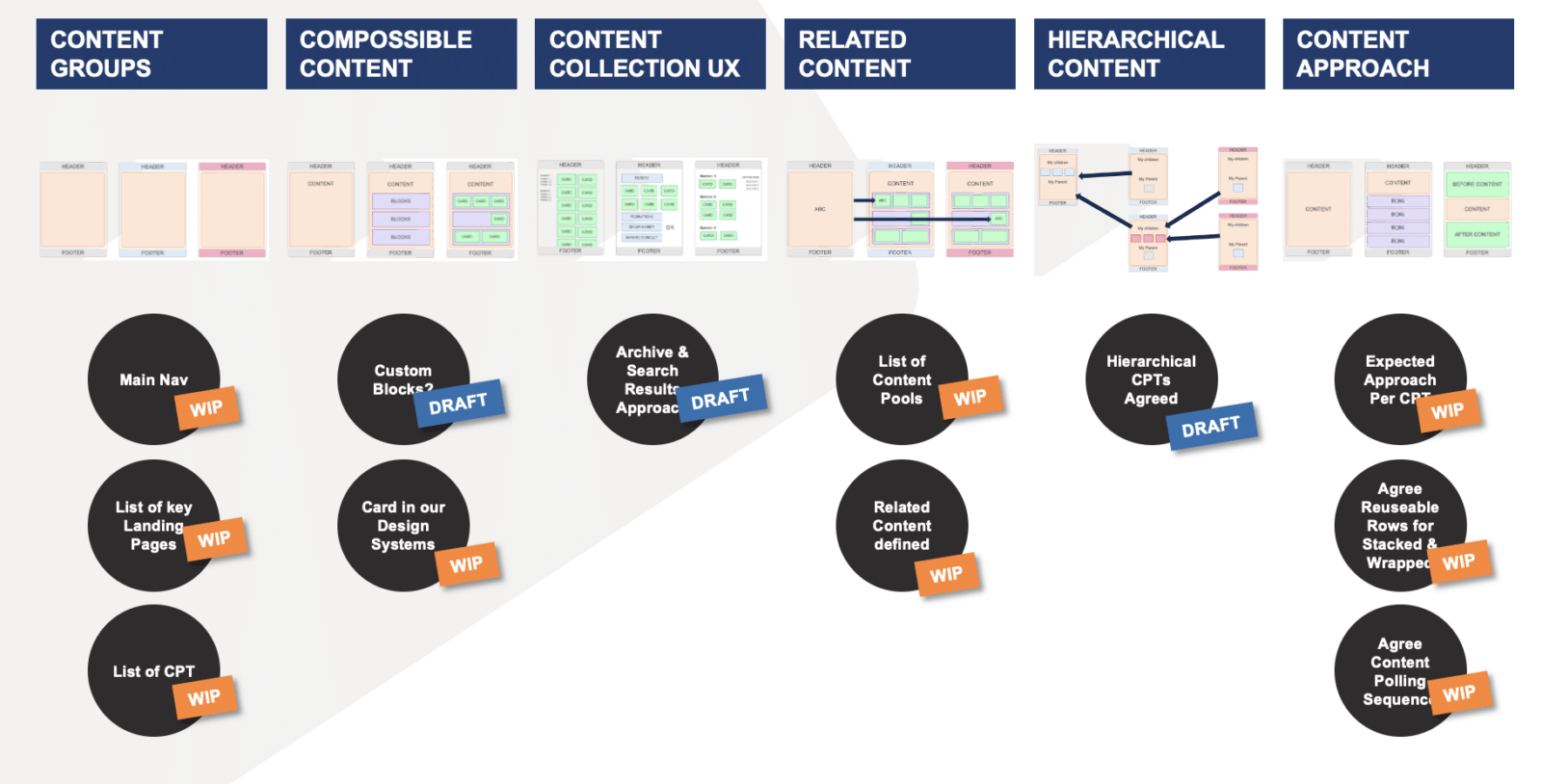
Rather than beginning with a sitemap and treating the page as the fundamental unit of the website, we identify what the organisation’s information actually represents. Programs, services, people, locations, events, stories, campaigns and resources become meaningful content types with their own attributes and relationships.
A program, for example, might have a name, description, audience, location, dates, eligibility, cost, related people, events, stories and calls to action. Those attributes belong to the program itself rather than to whichever page happens to present it.
At the same time, we begin giving clearer form to how people will find and navigate that information. Some pathways will be hierarchical, some will be driven by audience or interest, and others will emerge through search, related content and relationships between content types. The navigation system therefore begins to reflect both what the organisation needs to communicate and how its audiences are likely to look for it.
SEO and broader discoverability are part of the same thinking rather than something applied at the end of the project. Understanding how audiences describe their needs, what they search for and how the organisation’s information should be grouped helps shape content types, naming, hierarchy, metadata and the relationships between information. The structure needs to make sense to people, search engines and increasingly AI-driven discovery systems.
The audience model developed earlier becomes particularly useful here. Content can be associated with relevant archetypes, interests and engagement life stages without being permanently embedded inside a page designed for one particular audience. That creates the foundations for different navigation pathways, related content, search, future personalisation and experiences that can change as the organisation evolves.
The objective is not to turn every paragraph into a database field. We structure information where doing so creates genuine value through reuse, relationships, consistency, search, filtering or future flexibility, while leaving editorial content appropriately flexible.
By the end of Content Modelling, the future site is beginning to have a recognisable structure. We understand the major types of content, how they relate, the emerging navigation systems through which audiences will discover them, and the SEO and discoverability framework that helps connect audience needs with organisational information.
5. Content Planning
Content Modelling gives us the structure of the system: the types of content we expect to manage, their important attributes, how they relate to one another and the emerging navigation and discoverability structures around them.
The next step is to develop a Content Plan: what do we currently expect to fill that model with?
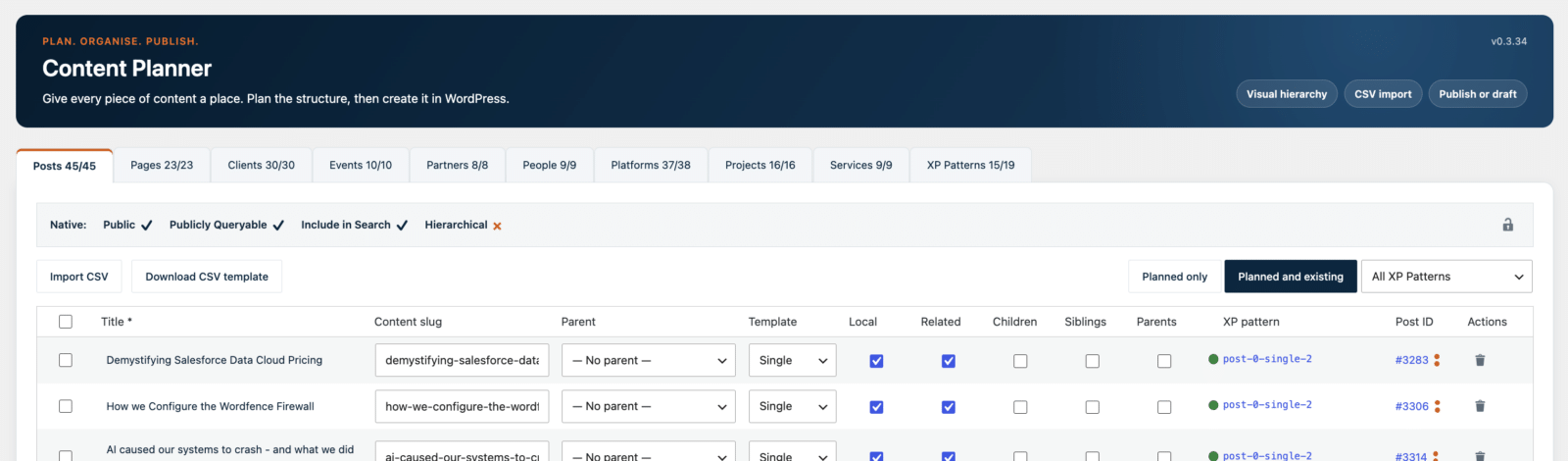
The Content Plan is not intended to be a perfect or literal specification of the finished website. Like any useful plan, it gives us direction, establishes expectations and provides something tangible to work towards while accepting that our understanding will continue to develop as the project progresses.
If we have established Programs, People, Locations, Stories, Events or Resources as content types, we begin identifying the actual programs, people, locations, stories, events and resources we expect the new system to contain. Alongside those content pools, we identify the broader pages and experiences we currently expect to need: major landing pages, audience pathways, organisational content, campaigns and other parts of the emerging site.
This gives us an increasingly complete picture of the future website without requiring every page to have been written or designed. It allows us to test whether the content model is sufficiently complete, whether the emerging navigation makes sense and whether the needs identified through our audience model have somewhere to be addressed.
It also creates practical expectations around content. We can identify what already exists and can be reframed, what should be consolidated, where genuine gaps exist and where materially new content may eventually be required. This allows content effort to be understood and managed rather than discovered unexpectedly during design or build.
The Content Plan also gives us enough structure to begin establishing the complete site. Placeholder pages can be created for the experiences we expect to build, even though their final content and presentation have not yet been determined. This allows navigation, hierarchy, URLs and relationships to begin taking shape around a representation of the whole site rather than only the content that has already been completed.
Those placeholders are deliberately provisional. Some will become substantial standalone pages. Others will become highly assembled experiences drawing from multiple content pools. Some may merge, disappear or change purpose as the project develops.
That is why this is a plan rather than a specification. Its purpose is not to predict the finished website perfectly. It is to give the project enough direction and shared expectation to move confidently into the next stage.
6. Content Pooling
With the content model and Content Plan established, we can begin moving real content into the new system.
The experiences we eventually create will sit on a continuum. At one end are pages that contain largely their own substantive content: a story, program, service, person, location, resource or other piece of information that can meaningfully stand on its own. At the other end are highly assembled experiences that may contain very little unique content of their own, instead bringing together related information from many different parts of the system.
We start with the first group.
These relatively self-contained pieces of information form our content pools. Rather than immediately trying to recreate every finished experience, we take the content identified during the stocktake and begin moving it into the content types and structures established through Content Modelling.
This is where rationalisation and migration happen together. Existing material can be retained, consolidated, lightly reframed or retired. Where the same information currently appears in several places, we can identify an authoritative source rather than carrying that duplication into the new system.
A program becomes part of the Program pool. A person belongs in the People pool. Stories, locations, services, events, resources and other meaningful content are treated in the same way. Each piece of content is structured according to what it is, rather than according to where it happened to appear on the old website.
At the same time, the placeholder structure established through the Content Plan allows the broader site to begin taking shape. Navigation can operate across the expected site structure and relationships can begin connecting pooled content with experiences that have not yet been fully designed.
This creates an important separation between content and experience. The content pool does not need to know every page, journey or experience in which its information will eventually appear. It provides the underlying information; later work determines how that information should be assembled and presented for different audiences and purposes.
That separation also changes the content-maintenance cycle. In a traditional page-oriented website, changing a piece of information can mean finding every page on which it has been repeated and updating each occurrence. In the pooled model, the aim is to maintain information once at its source and allow the experiences that reference it to reflect that change.
Starting with the content pools gives us real material with which to design the more complex experiences that follow. Instead of designing landing pages and journeys around placeholder content, we increasingly have structured, rationalised organisational content available to assemble.
By the end of Content Pooling, we have established much of the source material of the future digital system, while also having a working skeleton of the broader site through which navigation and relationships can already operate.
7. Experience Design
By this stage, we have most of the ingredients we need. We have …
- an audience model,
- an emerging navigation and content architecture,
- base atoms, a visual language and design system,
- structured content pools and a Content Plan
Now we bring those things together.
Most organisational websites have a core offering: products, services, programs, events, courses, locations or some equivalent representation of what the organisation actually does. We typically start there because these experiences sit close to the centre of both the organisation’s story and its audiences’ needs, and give us broad coverage of the visual systems to refine the experience that will influence the whole site.
We also start at the top of the experience and work down. We establish how …
- the global navigation works,
- how the page introduces itself through its hero and primary messaging,
- how breadcrumbs and other wayfinding operate,
- how local content is presented,
- how related content is drawn from the wider content pools, and
- how the experience resolves through calls to action and the footer.
This gives us our first complete expression of how the system works as an experience rather than as a collection of separate ingredients.
From there, we work through the content-pool experiences. Programs, people, stories, events, locations, resources and other structured content types need appropriate ways of presenting their own information while also exposing their relationships with the rest of the system. Because the underlying content has already been pooled and related, these experiences can increasingly draw relevant information into the page rather than requiring editors to manually recreate it.
Finally, we work through the remaining experiences identified in the Content Plan. These are often further towards the assembled end of the spectrum: landing pages, audience pathways, campaigns and other experiences that may contain relatively little unique content of their own and instead bring together information from across the content pools.
Importantly, Experience Design happens in the site itself.
We are not producing a succession of static mock-ups that are approved and subsequently handed to somebody else to reproduce in code. We use the real design system, real components, real content and real relationships to design the experience where it will ultimately operate. When something works, it is already part of the site.
This inevitably refines the Atomic Design system established earlier. Real experiences expose states, combinations and requirements that could not reasonably have been anticipated when the initial atoms and visual language were created. Components are adjusted, new patterns emerge and existing ones become more sophisticated.
That refinement is expected. The system was deliberately built for change.
The important discipline is that improvements discovered through one experience are considered as improvements to the wider system. A useful new pattern should become available elsewhere rather than remaining a one-off solution embedded in a particular page.
By the end of Experience Design, the site should be substantially real. A useful way to think about the target is 80% wide, 80% deep and 80% visually resolved. Most of the planned site exists, most of the meaningful content and relationships are operating, and the experience looks and behaves substantially as intended.
It does not need to be perfect. The remaining work is refinement rather than invention.
That is a very different position from completing a set of approved mock-ups and then beginning the website build. We already have the system, the content and most of the experience operating together.
We have designed by building.
8. Site Building
By the time we reach Site Building, there should be very little about the website that is still abstract.
The site is already substantially assembled. The content pools are populated, navigation and relationships are operating, the major experiences have been designed in the site itself, and the Atomic Design system has evolved into a practical set of reusable components and patterns. We are starting from something that is approximately 80% wide, 80% deep and 80% visually resolved.
Site Building is therefore not the traditional moment where approved mock-ups are handed to developers and development begins. Much of that work has already happened as part of Experience Design. This stage is about completing the wider digital system and bringing the remaining parts of the implementation up to the same level of maturity.
That includes completing functionality and integrations that sit behind or across the experience. Forms and their submission behaviours are completed, search is refined, analytics and conversion measurement are implemented, CRM and other integrations are connected,
A website is the outcome, not the system
Build for the next change
At the end of this process, we have launched a website. But the better test of what we have built comes afterwards.
What happens when the organisation introduces a new program? What happens when an audience becomes more important, the strategy changes, a proposition needs to be reframed or the brand is refreshed? Can the organisation make those changes through the system it now owns, or does changing the story once again mean changing the website underneath it?
That is where the sequence matters. Content exists in reusable pools rather than being unnecessarily repeated across pages. The audience model provides a continuing framework for considering who an experience needs to serve. Atomic Design gives the organisation a visual system that can evolve. Content Modelling provides structures and relationships that allow information to be reorganised, while Experience Design creates patterns that can be reused and recombined as new needs emerge.
The result is not a website designed never to change. It is almost the opposite: a website designed on the assumption that it will change.
That does not remove the need for future design and development. New ideas will require new capability, brands will evolve and technology will continue to move. The difference is that normal organisational change no longer needs to begin with the assumption that the website itself must be replaced.
Why hierarchical Salesforce campaigns create more marketing value
There is a persistent debate about how campaigns should be organised in Salesforce. Some teams prefer a flat structure, where every campaign sits at the same level. Others use broad or long-running campaigns to group people around a topic or activity. Both approaches can serve a purpose, but simplicity is not the only measure of a useful campaign model.
Well-designed campaign hierarchies can help marketing organisations interpret engagement more meaningfully and govern activity more consistently. Specific campaigns capture targeting and responses, their position in the hierarchy provides context, and carefully defined roll-ups turn those records into useful measures. The question is not simply where to store a list of people, but what campaign membership should tell us about them.
Treat campaigns as signals
Salesforce campaigns often begin life as administrative containers. A team creates a campaign, adds some members and uses it to support an email, event or advertising activity. Campaigns become more valuable when membership carries a defined meaning.
A campaign might tell us that someone was part of an audience marketing intended to target, registered for an event, completed a form, attended something or requested further contact. Viewed together, those memberships create a history of the relationship between marketing activity and individual engagement.
This requires an important distinction. Inclusion in an outbound audience records marketing’s intention to target someone, but it does not necessarily prove that the person saw the message. An inbound response provides stronger evidence of something the person actually did. Both signals are useful, provided we do not confuse them.
Separate outbound intent from inbound engagement
In this model, inbound and outbound describe two different campaign purposes. They are operating conventions rather than standard Salesforce campaign categories, and they can be organised as separate campaign hierarchies.
The outbound hierarchy describes what marketing is trying to influence. It contains the audiences, activities and individual executions used to reach people. In MCN, where each email send is represented as a separate Salesforce campaign, hierarchy becomes particularly useful because those sends can remain distinct without becoming a flat collection of unrelated records.
The inbound hierarchy describes what people actually do. It might represent registrations, memberships, donations, applications, event participation or other forms of engagement. The two structures do not need to mirror each other, because marketing may target people with the intention of increasing participation in a programme while those people ultimately engage through several different pathways.
Together, the two hierarchies give us complementary views of what marketing intended to influence and what people actually did.
Let the business shape the hierarchy
There is no single hierarchy that suits every organisation. Both inbound and outbound structures will often begin with a financial or calendar year and work down towards a specific activity or engagement instance, with the important design work sitting in the levels between.
An outbound hierarchy might follow a pattern such as:
Financial year → Objective → Activity → Execution
An inbound hierarchy might look more like:
Financial year → Programme → Location → Engagement Instance
These are patterns rather than rules. The right structure depends on how the organisation works: how new people enter, how existing people re-engage, and which programmes, services, locations, audiences or activities matter enough to report on. Those answers should shape the hierarchy, which is why campaign design is really an exercise in understanding the business rather than simply configuring Salesforce.
Understand the individual, not just the list
Imagine opening a person’s Salesforce record and seeing the outbound campaigns they were targeted through and the inbound campaigns through which they engaged. That history can reveal the programmes or subjects marketing believed were relevant to them, the activities they responded to, and the pattern and recency of their engagement.
The meaning comes from the combination of the campaign, its position in the hierarchy and the member’s status. A status such as “Targeted” means something different from “Registered”, “Attended” or “Requested Contact”, so consistent Campaign Member Statuses are central to the model. They should describe the person’s relationship with that campaign rather than act as vague substitutes for their overall customer or lead stage.
Turn engagement into future understanding
Campaign membership should preserve the interaction that actually happened. If someone joins an inbound campaign because they registered, attended, donated, applied or completed another engagement, that campaign becomes part of their history.
From there, the engagement can create other signals that are more useful for future marketing. In our implementations, campaign membership can trigger marketing tags that represent an emerging or confirmed interest. Someone engaging with a particular programme, service or subject can therefore build a richer interest profile over time without using broad evergreen campaigns as a substitute for their engagement history.
This separation is useful. Campaigns tell us what happened and in what context. Marketing tags help us understand what that behaviour may tell us about the person and what might be relevant to them next.
Why hierarchy adds value
Detailed campaigns explain individual interactions, but marketing teams also need to understand the broader initiative behind them. A campaign hierarchy connects those views by allowing a specific campaign to tell us that someone participated in a particular event or received a particular send, while its parent campaigns provide the programme, activity or reporting context around that interaction.
Salesforce supports campaign hierarchies of up to five levels, which makes hierarchy design important. Each level should have a clear reporting or governance purpose rather than simply acting as another filing category. Campaigns can have many useful attributes, including programme, audience, channel, location and direction, but not all of them need to become hierarchy levels. Other dimensions can be represented as fields and used in reporting, leaving the hierarchy to represent the relationships that matter most.
Use roll-ups carefully
Salesforce provides standard hierarchy statistics that aggregate defined campaign metrics from child campaigns. Where an organisation needs more selective calculations, tools such as Declarative Lookup Rollup Summaries (DLRS) can be used to create filtered roll-ups.
This allows the hierarchy and the measurement rules to do different jobs. The hierarchy explains how campaigns relate to one another, while the roll-up rules define which records contribute to a particular measure. That distinction matters because campaign placement should follow the business meaning, while measurement should follow the definition of the metric.
Be precise about what the numbers mean
A sophisticated hierarchy can still produce misleading reporting when the measures are poorly defined. If two campaigns each contain 100 members, adding those totals produces 200 campaign memberships, but it does not necessarily mean that 200 different people were reached.
Filtering and deduplication are separate problems, so each reported measure should make clear what is being counted, which Campaign Member Statuses qualify, whether the result represents memberships or distinct people, and what has been included or excluded. A visible number is only useful when its meaning remains intact.
Consistency matters more than any single pattern
The biggest risk is not choosing the “wrong” hierarchy. It is failing to commit to a campaign model at all.
When inbound, outbound, flat and evergreen approaches are mixed together without clear rules, campaign membership becomes difficult to interpret. The same type of record may mean different things in different parts of Salesforce, roll-ups become less reliable, and marketers are left guessing whether a campaign represents an audience, an activity, an engagement or an ongoing interest.
A well-designed model avoids that ambiguity by giving each concept a clear role. Outbound campaigns represent marketing intent and execution. Inbound campaigns represent actual engagement. Longer-term interests can be carried forward as marketing tags or other attributes rather than being mixed into the campaign structure.
The specific hierarchy can vary between organisations, but the conventions should be deliberate and consistently applied.
Hierarchy as a governance framework
The value of hierarchy extends beyond reporting. A defined structure gives marketers a common answer to practical questions such as when a new campaign should be created, where it belongs, how it should be named, which statuses it should use and which totals it should contribute to.
A hierarchy does not create governance automatically. The organisation still needs conventions, ownership and maintenance, but it gives those conventions a visible structure inside the platform where people actually work.
A foundation for future engagement
Good campaign structure also creates a stronger foundation for what happens next. Salesforce reports can be used to identify groups of people and add them to campaigns, allowing what we learn about someone to become part of their future engagement history rather than remaining trapped in a report.
Campaign Member data adds another layer. Alongside status and response information, we commonly capture attribution data such as UTM source, medium and campaign through our webhooks. That makes the Campaign Member record useful not only for showing that an engagement happened, but also for preserving context about how it happened.
Combined with marketing tags, this creates a richer picture over time. Campaigns preserve the events and activities, Campaign Member fields preserve the detail of individual interactions, and tags carry forward useful signals about likely interests.
This becomes increasingly valuable as AI is introduced. A structured history of what someone was targeted with, what they responded to, how they arrived and which interests have emerged gives AI much better context for summaries, recommendations and future personalised engagement.
The value of campaign architecture is therefore not only better reporting today. It is also about creating richer, more structured data that can support better decisions and more relevant engagement tomorrow.
Flat structures remain valid
A flat campaign structure is not inherently wrong. It may be entirely adequate for an organisation with relatively few campaigns, simple reporting requirements or strong external reporting tools.
The case for hierarchy becomes stronger as the organisation needs to connect detailed activity to broader programmes, understand engagement in context, manage campaigns consistently across teams and govern a growing volume of marketing activity. The comparison is not between a correct model and an incorrect one, but between different levels of organisational need.
A stronger foundation for marketing
A useful Salesforce campaign model should help marketers understand both sides of the relationship: what did we try to influence, and what did people actually do?
Hierarchical campaign structures help connect those views. Specific campaigns preserve the signals, parent campaigns provide context, roll-ups turn those records into useful measures, and governance keeps the model consistent.
Used this way, campaigns become more than buckets of names. They become a structured account of marketing intent, individual engagement and how those activities contribute to the organisation’s wider programmes. That structure improves reporting today and creates richer context for AI summaries, recommendations and more personalised engagement in the future.
What Does a Good Managed Services + Product Owner Cadence Look Like?
In our previous article, we talked about what it means to become the Product Owner of an important business platform. It’s an opportunity to shape where the product goes, what gets better and where future investment and effort are focused.
The good news is that you don’t need to figure out how to do all of that on your own.
One of the benefits of having a Managed Services partner is having people alongside you who know the technology, understand the history of your solution and can help you make sense of what you’re hearing from the business. You bring your understanding of the organisation, its people and what you’re trying to achieve. We bring our understanding of the technology, what we’re seeing through support and delivery, and experience continually evolving platforms like yours.
A good Product Owner and Managed Services cadence is really about creating a simple rhythm for bringing those perspectives together. It shouldn’t require hours of additional meetings or turn Product Ownership into another job. For many products, it can be as simple as a 30-minute conversation each week, a slightly longer look ahead once a month and a shared view of where we’re going.
Bring us what you’re hearing
You don’t need to arrive at our conversations with a perfectly groomed backlog or a collection of fully formed requirements. Bring us what you’re hearing.
Maybe several people are struggling with the same part of a process. Someone has an idea they think would make their job easier. A team isn’t adopting something we thought they would. There are recurring support requests. A new business priority has emerged. Or perhaps something just doesn’t feel like it’s working as well as it should.
These are all useful signals.
The real value comes from having a regular conversation with someone who carries the voice of the business. Something you raise this week might not feel particularly significant. We talk about it, perhaps help in the moment, and move on. Then something similar comes up next week. Individually, neither moment may have justified changing the product, but together they start to tell us something.
This is where we can step above the individual requests and look for themes. What are we seeing? What does it really mean? How important does it feel? And what, if anything, should we do about it?
Over time, those regular conversations build shared context. Eventually we might find ourselves saying,
we’ve talked about this a few times now; this feels like something worth addressing. Let’s plan for it next month.
That’s continuous improvement in practice.
Sometimes the answer is more than one thing
Identifying a theme doesn’t mean the answer is automatically to build something.
Perhaps people aren’t aware of something the platform can already do, so we can train them on a better way to work now. There might be a process we can change immediately to make things easier. We might also identify a small product improvement worth making next month while recognising that there is a larger capability we want to come back to later.
The response to one theme could quite reasonably be:
- train this now,
- change this process,
- build this next and
- release something larger later.
This is where having the business and technology perspectives together becomes valuable. You know what people are experiencing and what the organisation is trying to achieve. Your Managed Services partner can help you understand what the technology already does, what could change, what other parts of the solution might be affected and what different options might look like.
Neither side needs to arrive with the answer. We work it out together.
A simple 30-minute weekly rhythm
For a product with a steady flow of business needs and opportunities, the cadence itself can be remarkably simple. Thirty minutes, once a week, starting with the same question:
What’s new?
This is your opportunity to bring the voice of the business into the conversation. What have you heard since we last spoke? What’s changed? Has something come up repeatedly? Is there a new pain, opportunity or priority we should know about? We don’t need to solve everything there and then. Sometimes the most useful thing we can do is hear it, talk about it and see whether it connects with anything else we’re seeing.
From there, loop through what’s In Progress. This shouldn’t become a detailed project status meeting. Give a quick update, identify anything that’s blocked and surface any decisions or input we need from you. If everything is moving, keep moving.
Then look at what’s next. Is the work sitting in the current month still practical to achieve? Have priorities changed? Is there too much there? Leave some stretch items if that’s useful, but be realistic about what the delivery team and the business can actually deliver, test, adopt and absorb. Move the balance into future months rather than allowing the current month to become an ever-growing wish list.
Do as much of that as you can in 30 minutes. Then stop and do it again next week.
The board shouldn’t only move during the meeting either. Both the Product Owner and Managed Services team should review it beforehand and come prepared. Updates, housekeeping and moving obvious items can happen in the background during the week. The meeting is valuable conversation time, not board administration time.
Make the roadmap something you can move
A simple Kanban-style board can become one of the most useful tools in the relationship. Trello, Monday, Confluence or whatever shared tool you already use can work.
The useful part is the model behind it. Rather than one enormous backlog, use time as part of the structure. Start with a What’s New? column for emerging ideas, pains, opportunities and themes. Upcoming months become planning buckets, with In Progress for active work and previous months retained as a history of what has been completed.
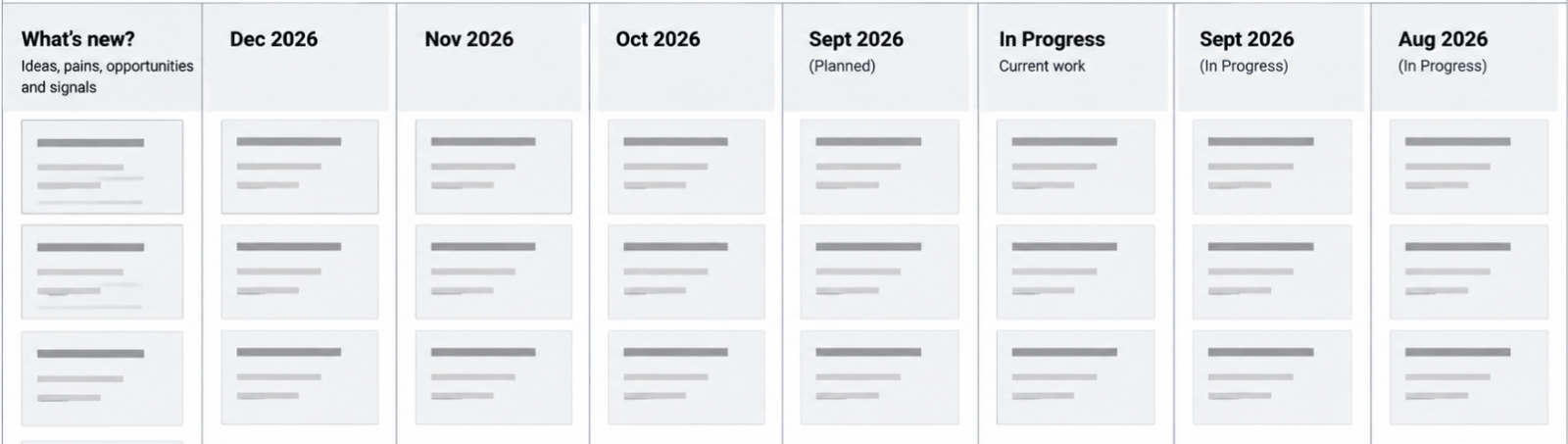
The months aren’t fixed commitments. They help us organise priorities and have practical conversations about capacity. Something might sit in What’s New? while we learn more, then become important enough to say, let’s put that into next month. Keep some stretch items in each month, but if there is clearly too much, move things forward.
Over time, the board gives everyone a simple view of what we’re hearing, what’s coming next, what’s happening now and what we’ve already achieved.
The conversation finds the themes. Time gives them a place. The board keeps them moving.
Once a month, look a little further ahead
Once a month, make the weekly session an hour. Use the first 30 minutes for exactly the same rhythm you use every week: what’s new, what’s in progress and what’s next. Then use the second half to lift your eyes a little further.
Look properly at next month and the month after that. Given everything we’ve learned over the last few weeks, do the things sitting there still feel right? Are themes emerging that now deserve a place? Has something become less important? Are there dependencies we need to prepare for? Is the amount of change realistic for the capacity available?
This is also a useful opportunity to look at pace. Are we moving at roughly the rate we expected? Is there room to bring something forward? Are we consistently carrying too much from one month into the next? Is there a larger enhancement on the horizon that might need additional investment or planning?
This isn’t about locking down another project plan. It’s about maintaining enough certainty about what comes next that everyone can move with confidence, while leaving enough flexibility to respond to what we learn.
Plan for value and the capacity for change
A Managed Services relationship has capacity. So does the business. Both matter.
There may be enough delivery capacity to make ten changes, but if the business only has the capacity to test, adopt and absorb three, delivering ten isn’t necessarily success. Equally, a Product Owner might identify twenty genuinely valuable opportunities, but that doesn’t mean they all need to happen immediately.
The board makes those trade-offs visible. We can keep some stretch items in the current month and pull them forward if things move faster than expected. We can move other things into future months knowing they haven’t been forgotten. And when something genuinely becomes more important, we can bring it forward and consciously move something else.
That is very different from continuously adding things to a backlog and hoping we eventually get to them. We’re organising change around value, impact and the capacity to absorb it.
Don’t combine Product Owner cadences
If you have multiple Product Owners across a connected ecosystem, it can be tempting to bring them all into the same weekly Managed Services conversation. Generally, we wouldn’t.
Each Business Product Owner benefits from having their own regular conversation because their product, users and needs are different. A CRM Product Owner might talk about processes, reports, flows and configuration, with many of those conversations leading to product change. A Marketing or Digital Product Owner might talk about audiences, engagement, campaigns, conversion and analytics, with the conversation leaning more towards strategy, advice and making better use of the capabilities they already have.
The person they meet with from the Managed Services team may be different too. The CRM Product Owner might benefit from someone who knows their solution and can help shape functional change, while the Marketing Product Owner may get more value from someone bringing marketing, digital and engagement expertise. The cadence should connect the Product Owner with the people best equipped to help them make their product better.
IT and Data Product Owners can work differently again. They are often more on demand, becoming involved when a need, opportunity or risk emerges: we need to think differently about PII, or I think we’ve identified a data risk. Those conversations may need architecture, data or integration expertise rather than a standing weekly cadence.
Combining all of this into one meeting can actually reduce its value. People spend time listening to conversations that don’t need them, while the conversations that do matter get less time and less access to the right expertise. Collaboration doesn’t require everyone to be in everything.
Keep the individual cadences focused and bring people together when there is something worth connecting. For closely related products, an additional monthly cross-product conversation can still be useful for looking ahead at dependencies and shared impacts, but it should complement the individual relationships rather than replace them.
Give each Product Owner the conversation they need, with the people they need, then connect those conversations when it matters.
Keep it simple and keep talking
That’s really what a good Managed Services and Product Owner cadence looks like. And it doesn’t need to look identical for every product.
Where there is a steady flow of business change, start every week with what’s new? Listen for the voice of the business and the themes beginning to emerge. Quickly check what’s in progress and clear anything getting in the way. Look at what’s next and make sure the current month remains realistic. Keep the board moving in the background rather than spending your meeting administering it.
Once a month, spend another 30 minutes looking ahead and shaping the next couple of months. Where there are multiple related products, occasionally bring those Product Owners together to look across the ecosystem without turning every decision into a committee decision.
Then do it again next week.
The value isn’t in the meeting itself, the Kanban board or having the perfect backlog. The value is in the continuity of the conversation. Something that seems small today can connect with something we hear next week, and over time those signals help us recognise where attention and investment will create the most value.
You don’t need to manage all of that alone. Bring us what you’re hearing from the business and where you want to go. We’ll bring what we’re seeing through support and delivery, what we know about the technology and the experience to help you give it shape.
Keep talking, keep learning, and together we’ll keep making the product better.
You’ve Been Made the Product Owner.
Now What?
You’ve been told you’re the Product Owner for Salesforce, your marketing platform, fundraising platform or another important business system.
So, what exactly have you just become responsible for?
Product Owner is one of those titles that sounds reasonably self-explanatory until you actually have to do the job. You might not administer the platform. You may not be particularly technical. There may already be an internal IT team, an implementation partner or a Managed Services partner responsible for much of the work. You probably don’t manage everyone who uses the product either.
Yet somehow, you’re now its owner.
At its simplest, a Product Owner is accountable for the direction, priorities and ongoing evolution of a product. Your job is to understand what the product is there to achieve, who it serves, where it needs to improve and what matters most next.
That doesn’t mean you need to know how to build everything. In fact, one of the most important distinctions in Product Ownership is between what and why and how. You should be able to explain what the business needs, why it matters, who it affects, how important it is and what a good outcome would look like. Your technical teams and delivery partners can then help determine how best to achieve it.
In practical terms, that means taking responsibility for a number of things:
- Own the product direction and priorities. Decide what matters most, where the product needs to go and what should happen next.
- Maintain and prioritise the product backlog. Balance strategy, business needs, user feedback, support insights, defects and opportunities rather than treating the backlog as a queue of requests.
- Triage support demand. Users should be able to report the pain, problem or opportunity they experience without diagnosing the underlying technology or prescribing the solution. You help determine whether the need is support, training, process change, a defect or a genuine product improvement.
- Protect the product from drift. User feedback and support demand should inform the roadmap, but the product shouldn’t be shaped by the loudest user, the most recent request or simply the greatest number of requests.
- Define what and why, not necessarily how. Articulate the problem, desired outcome, importance and what good looks like, then work with technical and delivery specialists to determine how best to achieve it.
- Understand the product ecosystem. Know the important upstream and downstream influences, integrations and hand-offs affecting your product. You don’t need to be the expert in all of them, but you need to know when your decisions have consequences beyond your product.
- Collaborate across product boundaries. When an issue or opportunity involves another platform, work with its Product Owner rather than expecting users to understand or navigate the underlying architecture.
- Own value, not just change. Consider adoption, training, usability and business outcomes, not simply whether functionality has been delivered.
Product Ownership is an important responsibility, but it doesn’t need to become your whole job. In many organisations, it is something you bring into the role you already have: a clearer responsibility for listening, setting direction, making priorities visible and helping shape how the product evolves. You don’t need to become the technical expert or spend every day managing a backlog. What you gain is the opportunity to influence how an important business product develops, make sure investment is focused where it can create the most value, and help turn the things you and your colleagues experience every day into meaningful improvement.
And you aren’t doing that alone. You bring your understanding of the business, its people and its priorities; your implementation or Managed Services partner brings their understanding of the technology and what it can do. Product Ownership is where those two perspectives come together.
You own the product, not the technology
For a business-facing platform such as Salesforce CRM, Product Ownership will often sit in the Business. That’s because most of the important decisions about its ongoing evolution are ultimately business decisions. How should we manage this relationship? Where is this process creating unnecessary effort? What information do our people need? What should we improve next? Which opportunity is more important?
That doesn’t mean every platform should be Business-owned. Enterprise-enabling products such as an integration platform or enterprise data platform may quite reasonably have IT or Data Product Owners because their primary responsibilities span multiple business products and include architecture, data, security, reliability and governance.
The important principle is that Product Ownership should sit close to where the product’s primary value can be understood and governed.
It can also change over time. During the very early stages of a major transformation, IT-led Product Ownership can make a lot of sense. When you’re replacing Dynamics with Salesforce, for example, the immediate risks may be migration, architecture, security, integration, data and establishing strong technical foundations. Once that platform moves into business requirement, however, the emphasis changes. The question becomes less about successfully establishing Salesforce and more about continually making Salesforce work better for the business.
The ownership model should be able to mature with the product.
Your backlog is not a list of requests
Once you’re the Product Owner, people are going to tell you what they want.
Some will have problems. Others will have ideas. Someone will want another field. Someone else will want a report. A team will have developed a workaround they want automated. A senior stakeholder will have seen something another organisation does and want the same thing. Support tickets will arrive. Your implementation or Managed Services partner will identify technical debt and opportunities. Vendors will release new capabilities.
All of these are signals. They are not automatically priorities.
One of the Product Owner’s most important responsibilities is turning those signals into a coherent product direction and prioritised backlog. That requires understanding the problem behind the request rather than simply accepting the requested solution.
But you’re not expected to do that alone. You know your business. Your implementation or Managed Services partner knows the technology. This is where the relationship between the two becomes really valuable.
As Product Owner, you should be able to have open and honest conversations about what you want for the business: what’s getting in the way, what you’re trying to improve, where people are struggling, what opportunities you can see and what outcomes matter most. You don’t need to translate all of that into a technical solution before bringing it to your partner. In fact, it’s often better if you don’t.
A good implementation or Managed Services partner can take that business context and bring their understanding of the platform, architecture and available capabilities to the conversation. Together, you can explore what is possible, challenge assumptions and find a better way to achieve the outcome. The Product
- Owner brings clarity about the business problem, the desired outcome and its priority;
- the partner brings clarity about how the systems can help achieve it.
This is where some of the best product decisions happen. Rather than the Business prescribing a solution and the partner simply building it, both sides bring their expertise to the problem. The result can be simpler, more sustainable and sometimes quite different from what either side would have proposed independently.
- Someone asking for another field may actually have a reporting problem.
- Someone requesting automation may have a broken process.
- A recurring support ticket may indicate a training problem rather than a technology problem.
- Something described as a defect may actually be the product behaving exactly as designed, but in a way users don’t understand.
The Product Owner needs to understand those differences, but they have a partner to help them do it.
This is why support should inform the product roadmap; it should not define it. The number of people asking for something matters, but Product Ownership isn’t product development by popular vote. Equally, the loudest person, most senior person or person who most recently raised an issue shouldn’t automatically determine what happens next.
Your job is to listen broadly, work with the people who understand the technology and decide deliberately.
Users should tell you what hurts
There is another important distinction when triaging demand: users shouldn’t be expected to diagnose the technology.
Modern platforms rarely operate independently. Salesforce might be connected to a fundraising platform, an integration platform, Data Cloud, a marketing platform, finance systems and a collection of other services. The person using Salesforce doesn’t need to understand any of that.
If they can’t see a donation they expect to see, that’s what they should tell you. They shouldn’t have to decide whether Salesforce is broken, Raisely hasn’t sent something, MuleSoft has failed or Data Cloud hasn’t resolved an identity correctly.
Users should report the pain, problem or opportunity in the product in front of them.
The Product Owner and supporting team can then triage that signal and determine what it means. It might require support, training, process change, defect resolution or a genuine product enhancement. Investigation might also determine that the underlying cause sits in another product.
That’s where another part of Product Ownership becomes important.
You own a product within an ecosystem
Having a Product Owner for Salesforce doesn’t mean that person owns every technology connected to Salesforce.
As we explored in our article, What Role Do Your Systems Play?, systems play different roles within an organisation. Some are systems of engagement, others provide identity and authority, integration, automation, knowledge or insight. Increasingly, the same platform may even play more than one of those roles. Understanding those roles helps us think about where Product Ownership should sit and, just as importantly, where the boundaries between products exist.
An organisation might have Salesforce CRM owned by Partnerships, Marketing Cloud and Raisely owned by Marketing, while Data Cloud and MuleSoft are owned by IT. Each has a different purpose, different users and different priorities, so separate Product Ownership can make good sense.
But those Product Owners cannot operate independently. The systems may have different roles and owners, but they are part of the same ecosystem. A change to Salesforce might affect an integration into MuleSoft, the data represented in Data Cloud or the audiences available to Marketing. A change in Raisely might alter what arrives in CRM. A new marketing requirement might depend upon data that originates somewhere else entirely.
A good Product Owner therefore understands the important upstream and downstream influences on their product. They don’t need to become an expert in every connected platform, but they need enough awareness of the ecosystem to recognise when a decision crosses a product boundary and when another Product Owner needs to be involved.
Ownership gives you authority within your product. It doesn’t give you authority over connected products.
The model works when there is clear ownership locally, cooperation at the boundaries and shared responsibility for the end-to-end outcome.
The Product Owner as the signal between Business and Delivery
All of this becomes even more important when an organisation is working with an implementation partner or Managed Services partner. In fact, I think Product Owner may be the most critical client-side role in making those engagements successful.
A delivery partner can bring architects, consultants, developers, administrators, analysts, testers and specialists. They can understand the technology, recommend approaches and deliver change. What they cannot independently determine is what matters most to your organisation.
Without effective Product Ownership, the partner is exposed directly to the noise of the business. Different stakeholders raise different priorities. Users submit enhancement requests. Someone escalates a support ticket. A meeting creates three new ideas. Another team wants something urgently. An executive asks whether a new feature can be implemented. Meanwhile there is technical debt to address, an existing backlog and strategic work already underway.
If all of those signals travel directly into delivery, the partner can become very busy without the product necessarily becoming much better.
Filter and focus
This is where the Product Owner creates enormous value. Their job isn’t to block the Business from the delivery team. It is to filter and focus what the Business is telling us into signals that delivery can respond to effectively.
That means listening to the noise and finding the patterns within it. It means separating symptoms from causes and problems from proposed solutions. It means identifying where several apparently different requests are actually manifestations of the same underlying issue. It means deciding when something is important enough to interrupt current priorities and when it belongs in the backlog.
Most importantly, it means providing delivery with clarity.
Instead of five users independently asking a Managed Services team for five slightly different Salesforce changes, the Product Owner might be able to say:
“We’re seeing a consistent problem with how our Partnerships team manages this part of the relationship lifecycle. Here are the users affected, here is what they’re trying to achieve, here is the business impact and this is now one of our priorities.”
That’s a very different signal. It gives the delivery team something they can investigate, design around and solve properly rather than simply implementing a collection of requests.
Protecting the product from drift
Most individual requests are reasonable. That’s what makes this difficult. Adding a field might genuinely help somebody. Changing a workflow might make one team’s job easier. Creating another automation might solve an immediate problem. None of these decisions necessarily looks damaging in isolation.
Over several years, however, hundreds of individually reasonable decisions can create a product nobody deliberately designed. Processes become inconsistent, fields proliferate, automations overlap and different teams solve similar problems differently. The underlying architecture becomes harder to understand and eventually the organisation begins describing the platform as complicated or difficult to use.
This isn’t necessarily the result of bad implementation. It can simply be the accumulated effect of change without strong Product Ownership.
The Product Owner protects against that drift by continually bringing decisions back to the product’s purpose, strategy and priorities. They don’t prevent change; they make change deliberate. Your implementation or Managed Services partner can challenge, advise and help you shape those decisions, but they shouldn’t become the de facto Product Owner. Ultimately, the decisions about what matters to the business and where the product should go need to remain with the organisation.
So, you’ve been made the Product Owner
Congratulations. You’ve been given the opportunity to shape a product that matters to your organisation and the people who use it. You have a voice in where it goes next, what gets better and where future investment and effort are focused.
Users will tell you what they’re experiencing. Stakeholders will tell you what they need. Support will show you where there is friction. Strategy will tell you where the organisation is going, and your technology partners will help you understand what is possible.
Your job is to bring those signals together and decide what they mean for the product.
That’s an important role — and a pretty exciting one to have.
Deterministic, Immutable and Other Words I’ve Picked Up From AI
I do a lot of vibe coding these days. We hear plenty about the importance of keeping a qualified human in the loop when working with AI. In my case, I am that human. I make sure the AI and I agree on the requirements, approach and solution before we start building, and I stay involved as we progressively design, build and test the result.
During those conversations, and throughout the build process, I’ve noticed something interesting. There are certain words and actions that AI comes back to again and again.
They’re not AI words. AI didn’t invent them. In many cases they’ve been part of software engineering for decades. Some I’ve known and used for years, some I’ve rarely had reason to use, and others describe familiar concepts with a level of precision that makes them particularly useful when a human and an AI are trying to agree on exactly how something should behave.
What interests me is how naturally they’re becoming part of the language of AI-assisted development. I suspect the next generation of designers, developers and solution people are going to hear them a lot more often too.
The danger is that we start repeating the language without really understanding what we’re saying. So I’ve started compiling a list of the words I keep encountering, what they actually mean and, perhaps more importantly, why they’re useful ideas in the first place.
Here are a few that keep coming up.
Deterministic
Something is deterministic when the same input, under the same conditions, produces the same result.
If I give a system A, B and C today and get X, I want A, B and C tomorrow to produce X again. That’s particularly interesting when we’re building with AI because AI itself can be probabilistic. Ask essentially the same question twice and you may get slightly different answers.
So when someone asks whether part of a solution is deterministic, they’re really asking a simple question: can we rely on this behaving the same way next time?
That’s often exactly what we want from software, even when we’re using a less predictable tool to help us build it.
Heuristic
A heuristic is essentially a practical rule of thumb. It won’t guarantee the right answer every time, but it gives us a useful way to make a decision when an exact answer would be difficult, expensive or unnecessary.
We use heuristics all the time without necessarily calling them that. If we decide that a piece of content over a certain length probably needs a summary, or that three failed attempts should trigger a different process, we’re using a simple rule to make a reasonable decision.
This makes heuristic a useful companion to deterministic. Sometimes we’re saying, “If A happens, B must always happen.” Other times we’re saying, “When we see A, B is usually a sensible thing to try.”
A heuristic isn’t a fact or a guarantee. It’s an informed shortcut that’s useful often enough to help us make a decision.
Immutable
Immutable means something can’t be changed after it has been created.
That doesn’t necessarily mean nothing can ever change. It means we don’t rewrite the original. If something changes, we create a new value, version or record while preserving what existed before.
Think of a historical transaction. If we change yesterday’s transaction every time our understanding changes, eventually we no longer have a reliable record of what actually happened yesterday.
Calling something immutable is therefore more than saying, “Please don’t edit this.” We’re saying that preserving its original state is part of the design.
Idempotent
Idempotent is probably one of the less familiar words on this list, but it describes a very useful idea.
Something is idempotent when you can do the same thing more than once without each repetition creating an additional unintended result.
Imagine we send a request to create a payment but don’t receive a response. Did the payment fail, or did it succeed and we simply didn’t hear back? We need to try again, but we certainly don’t want to charge the person twice.
If that operation is idempotent, we can safely repeat the request. The system recognises that we’ve already asked it to perform that particular action and doesn’t blindly do it again.
This comes up constantly in integrations, APIs and automation because retries are a normal part of building reliable systems. Networks fail, responses time out and processes get interrupted.
The useful question behind the word is wonderfully simple: what happens if we do this twice?
If the answer is “we accidentally create two of them”, idempotency might be something worth thinking about.
Scalar
A scalar is simply a single value.
That value might be a number, a piece of text, a true/false value or another simple value depending on the context. The important distinction is that we’re talking about one value rather than a collection, structure or more complex object.
If someone’s age is 51, that’s a scalar. If we have a list containing the ages of 100 people, we’re no longer dealing with a single scalar value. Likewise, "Sydney" can be a scalar value, while a customer record containing a name, address, phone number and email is a more complex structure made up of multiple values.
You’ll hear the term used in slightly different ways across programming, databases, mathematics and data systems, but the underlying idea is similar.
When AI says it “expects a scalar”, the useful translation is usually: give me one value, not a collection of things.
Smoke Test
A smoke test is a quick test to establish whether the important parts of something basically work before we spend time testing it more deeply.
We deploy a change. Does the application load? Can we perform the core action? Are the important components responding? Has anything obviously caught fire?
If the smoke test fails, there isn’t much point beginning a detailed test plan. We already know we have a fundamental problem.
That’s why you’ll hear AI coding tools suggest smoke tests so frequently. When we’re making lots of changes quickly, stopping regularly to establish that the thing basically still works is cheap insurance.
Drift
Drift is what happens when something gradually moves away from its intended or known state.
Code can drift away from the original architecture. Configuration can drift between environments. Documentation can drift away from what the application actually does. Even requirements and implementation can slowly become different versions of the truth.
The important word there is gradually. Drift doesn’t necessarily happen because someone makes one obviously bad decision. Lots of individually reasonable little changes can accumulate until what we have is no longer quite what we thought we had.
So when you hear someone talking about drift, the question underneath it is: are we still where we think we are?
Linting
Linting is automated checking of code for errors, suspicious patterns, inconsistencies and breaches of agreed coding conventions.
We’ve had linters for a long time. CSS linting, JavaScript linting and other forms of static code checking certainly aren’t inventions of the AI era. What AI-assisted development does is make linting an incredibly natural part of a very fast development loop.
Make the change, lint it, fix what the linter finds, test it and move on. A linter doesn’t prove the solution works, because that’s not its job. It catches a class of cheap, avoidable problems before they get further through the process.
That’s probably why I hear the word so much more now. AI can produce and change code quickly, and linting provides a fast way to check some of that work just as quickly.
Hydration
Hydration is one of those wonderfully visual words that modern web development has adopted for a fairly technical process.
A page can arrive from the server already containing its HTML and content. The browser then adds the JavaScript behaviour needed to make that page interactive. That process is called hydration.
The page is already there. Hydration brings it to life.
When you hear about a hydration error, it’s often because what the browser expected when it took over doesn’t quite match what was originally rendered by the server.
You don’t necessarily need to be the person fixing that problem to understand the conversation. If someone says, “This looks like a hydration issue”, you now have a pretty good idea which part of the journey they’re talking about.
Worker
Worker is a wonderfully ordinary word that has a more specific meaning when it turns up in a technical conversation.
A worker is essentially a piece of software given a job to do. Rather than everything happening inside the main application while a user waits, work can be handed off to a worker to process separately.
That job might be resizing an image, processing a queue, sending notifications, transforming data or responding to an event. Some workers run in the background, some run on a schedule and others wake up when something happens, do their job and disappear again.
You’ll hear the word used in slightly different contexts. A web worker can perform work away from the browser’s main thread. A service worker can sit between a web application and the network. A cloud worker can run code without us needing to think in terms of a traditional server sitting there waiting for requests.
The implementations are different, but the basic mental model is useful: there’s a job to do, so give it to a worker.
Once you understand that, a lot of conversations about queues, background processing and distributed applications become much easier to follow.
Canonical
Canonical means the recognised, authoritative or standard version of something when several possible representations exist.
Maybe several URLs can reach effectively the same content, but one is the canonical URL. Maybe information can arrive in several different structures, but we convert it into one canonical format before the rest of the system processes it.
In plain language, when someone asks, “What’s the canonical version?”, they’re asking: of all the ways this thing can exist, which one do we agree is the one?
That’s particularly useful when humans and AI are working together. Ambiguity creates problems quickly. Establishing the canonical representation gives everyone, human and machine, the same thing to work from.
Shape
Shape might be the least technical word on this list, which is partly why I’ve noticed it.
AI uses shape constantly. Shape the data. Shape the response. Shape the implementation. Shape the behaviour. Shape the solution around a particular requirement.
In this context, shaping something means deliberately giving it the structure or characteristics we need rather than simply accepting whatever form it happens to take.
We might receive data in one format and shape it into something our application can use. We might shape a response so it contains only the information required by the next process. Or we might shape an implementation around a set of constraints rather than allowing the technology to dictate the solution.
It’s a simple word, but it’s a useful distinction. Shape doesn’t necessarily mean create. Often the thing already exists. We’re organising, constraining or transforming it into the form we need.
And perhaps that’s why it works so well in conversations with AI. Much of what we’re doing isn’t asking AI to invent something from nothing. We’re progressively shaping an idea, requirement or implementation until it becomes the solution we actually want.
Why These Words Matter
None of these words are new, and that’s really the point.
AI isn’t inventing a new language for software development. What I think it is doing is exposing that language to a much broader group of people, while also making some existing engineering language much more common in our everyday conversations.
Someone who might previously have written requirements, designed an experience, managed a project or described what they wanted a solution to do can now sit beside an AI and progressively build that solution. Along the way, they’re going to find themselves much closer to the language and disciplines of software engineering than they might have been before.
I think that’s particularly important for the next generation coming into our industry. AI can remove a lot of the barriers to building something, but removing the barrier to writing code isn’t the same as removing the need to understand what we’re doing.
We shouldn’t learn these words because they make us sound more technical, and we shouldn’t simply repeat them because AI does. We should understand what they mean, the idea behind them and why someone chose that particular word in the first place. Once you do, many of them turn out to be remarkably good shorthand for ideas that would otherwise take a sentence or two to explain.
And there’s a slightly funny consequence I’ve noticed in myself.
After spending so much time talking to AI this way, these words have started escaping the AI conversation. I now find myself using them in my writing, in solution discussions and in everyday conversations with other people. Something has drifted. We need to shape the approach. Which version is canonical? Is the outcome deterministic?
Apparently, if you spend enough time talking to AI, it doesn’t just learn how you communicate.
You start picking up some of its vocabulary too.