
The Future of Marketing Is Here.
What Does Moving to Marketing Cloud Next Look Like?
Marketing technology is changing, and Salesforce Marketing Cloud Next presents an opportunity for organisations to rethink how they communicate with their audiences. With closer integration between marketing and CRM, more sophisticated audience segmentation, personalisation and automation, the platform promises to make marketing more connected, relevant and responsive.
For organisations already using Salesforce, the opportunity is particularly interesting. Much of the information needed to deliver more meaningful marketing experiences may already exist within CRM. The challenge is making that information available and useful to the marketing team, without creating an increasingly complicated collection of lists, segments, integrations and automated journeys.
But what does moving to Marketing Cloud Next actually involve? How much of your existing marketing operation needs to be rebuilt? Will you need to redesign your campaigns, retrain your team or reorganise your data? And how do you make the most of the new capabilities without turning a platform migration into an enormous transformation project?
At AlphaSys, our approach is to make the transition manageable while using it as an opportunity to improve the way your organisation engages with its audiences. Rather than simply recreating everything from your existing platform, we help you establish the core capabilities needed to operate Marketing Cloud Next effectively, then progressively build on those capabilities as your marketing requirements evolve.
Moving forward without starting again
Most organisations considering a migration already have an established marketing operation. They have email templates, mailing lists, automated journeys, consent arrangements and reporting processes that support their everyday activities. Some of these have been carefully designed, while others have developed organically as new campaigns, programs and requirements have emerged.
The first question is what should move across. It’s tempting to treat migration as a replication exercise, rebuilding every template, audience and journey exactly as it exists today. While this might appear to reduce change, it can also carry forward the limitations of the previous platform and miss opportunities to simplify the marketing operation.
We prefer to begin by understanding what you have and how it is being used. We review the existing marketing environment, including your templates, journeys, audience structures, brand assets and consent arrangements. We also look at the information already available within Salesforce and how it might support marketing activities in the new environment.
This doesn’t mean conducting an exhaustive audit of every campaign you’ve ever run. The objective is to understand the capabilities your team depends on, identify any important gaps and agree on what needs to be available when the new platform goes live. Some existing activities may be reproduced with relatively little change, while others present opportunities to take advantage of Marketing Cloud Next’s capabilities.
By establishing these priorities early, we can focus the migration on getting your marketing team operational without making the project dependent on rebuilding everything at once.
A better understanding of your audiences
One of the most valuable opportunities presented by Marketing Cloud Next is the ability to bring marketing activities closer to the audience information already held within Salesforce. Rather than maintaining separate lists and repeatedly preparing data for individual campaigns, marketing teams can begin working with audiences that reflect the organisation’s existing relationships and activities.
To make this useful, we spend time understanding how your organisation thinks about its audiences. Our Know Your Audience process considers three complementary dimensions: who people are, what interests them and where they are in their relationship with your organisation.
For example, an education organisation might engage with prospective students, current students, alumni and industry partners. These are different audience archetypes, each with different motivations and expectations. Within those groups, people may have interests in particular courses, disciplines, events or professional development opportunities. Their relationship with the organisation also changes over time, as someone moves from considering a course to applying, enrolling, graduating and eventually becoming an alumnus.
These distinctions help us establish a more useful approach to segmentation. Instead of creating a separate mailing list for every combination of audience, interest and activity, we can use structured information within Salesforce to identify the people relevant to a particular communication.
During the migration, we work with your team to establish an initial audience model and demonstrate how it can be used. This typically includes configuring a representative fixed audience, such as the recipients of a particular campaign, alongside a dynamic segment that updates as the underlying Salesforce information changes.
The intention isn’t to model every possible audience before going live. It’s to establish an approach your marketing team understands and can extend as new requirements emerge.
Making sense of preferences and consent
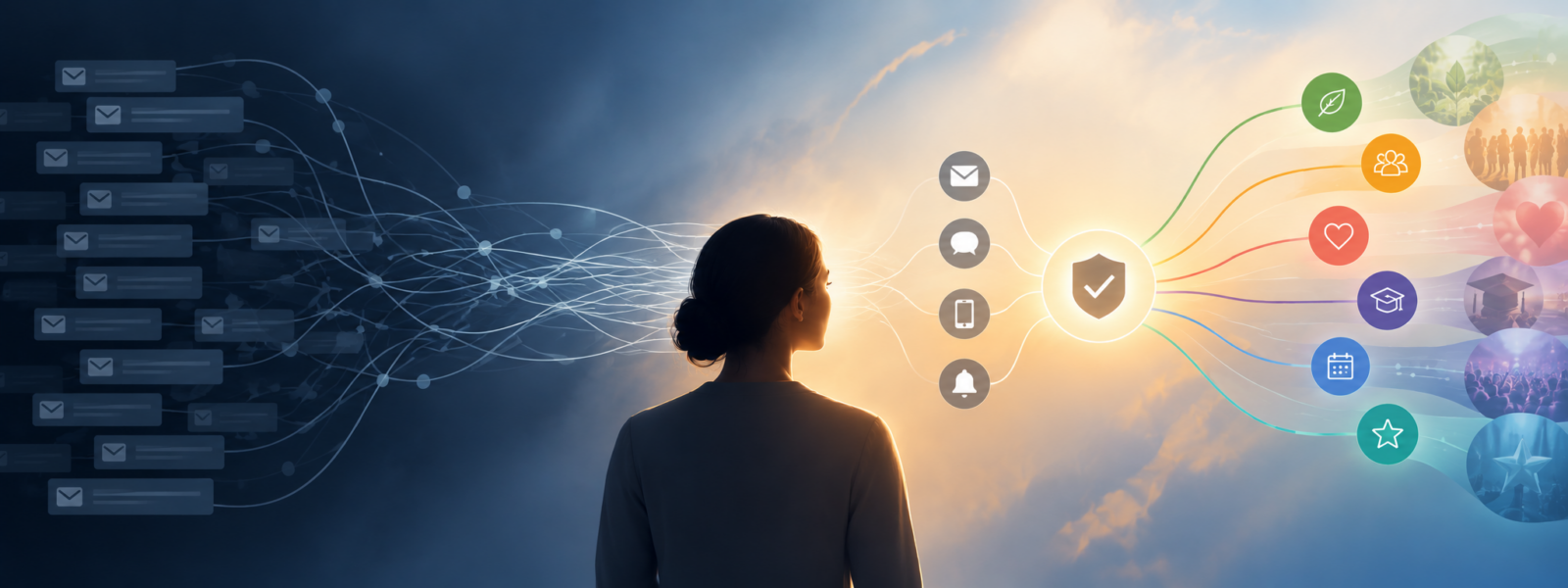
Audience segmentation is closely related to another important consideration: how people manage the communications they receive.
Many organisations have accumulated a collection of subscription lists, consent flags and preference fields over time. Some indicate whether someone has agreed to receive particular communications, while others describe their interests or relationships with the organisation. These are different concepts, but they are frequently managed together.
A migration provides an opportunity to clarify these arrangements. We review your existing consent information and preference centre, then work with you to establish a structure that supports both appropriate consent management and more meaningful audience preferences.
For example, someone might have consented to receive marketing communications but only be interested in particular programs or activities. By distinguishing their permission to receive communications from the topics that interest them, marketing teams can make more informed decisions about what to send.
Within Marketing Cloud Next, we establish the agreed preference centre and supporting tag structures. Where appropriate, existing fields can be transformed into tags, and processes that currently create those fields can be updated to support the new approach. Existing consent requirements and suppression rules remain important throughout this process.
This work helps avoid a common migration problem: carrying forward years of accumulated mailing lists and preference settings without reconsidering whether they still make sense. It also gives your organisation a more consistent way to introduce new interests, programs and communication opportunities in the future.
Establishing your marketing toolkit
While the audience work is progressing, we also establish the practical capabilities your marketing team needs to start using Marketing Cloud Next.
The technical setup includes configuring the environment, user access and permissions, sender settings and email authentication. We connect Marketing Cloud Next with Salesforce CRM and establish the foundational configuration needed to support the agreed marketing activities.
We then turn our attention to email creation. Most organisations already have established branding and a collection of templates, so the objective is not necessarily to redesign everything. Instead, we use your existing brand assets to establish reusable templates and components that make it easier to produce consistent communications.
This component-based approach allows marketing teams to assemble emails using established patterns rather than continually recreating layouts. It also provides a foundation for introducing personalisation, where different recipients can receive content relevant to their information or interests.
As part of the migration, we demonstrate standard personalisation capabilities, dynamic content variations and email experimentation. These allow your team to see how Marketing Cloud Next can support more sophisticated communications without needing to implement every possible variation immediately.
The emphasis is on establishing a practical toolkit that your marketing team can use independently, rather than delivering a collection of finished emails that require technical assistance whenever something needs to change.
Getting your first journey running
Automated marketing journeys are often among the most complicated parts of a migration. An established organisation may have numerous journeys supporting different audiences, campaigns and business processes, with varying levels of complexity.
Attempting to rebuild all of these simultaneously can make the migration unnecessarily difficult. Some may rely on data that isn’t yet available in Salesforce, while others may have been designed around limitations of the previous platform that no longer apply.
Our approach is to agree on a priority journey that can be established using information already available within Salesforce. This provides a practical opportunity to demonstrate how audience selection, communications, consent controls and reporting work together in Marketing Cloud Next.
For example, an organisation might choose a prospective student engagement journey. When someone meets an agreed set of criteria within Salesforce, they enter a sequence of communications designed to help them explore relevant study opportunities. The journey can use their available information to personalise communications, apply appropriate suppression rules and provide reporting on engagement.
The specific journey will depend on your organisation’s priorities. What matters is that it represents a genuine marketing requirement and establishes an approach that can be reused.
Once that first journey is working, your team has a practical reference for building others. Rather than learning the platform through abstract training exercises, they can see how the different capabilities come together in an activity relevant to their everyday work.
What happens during the migration?
For a focused initial Marketing Cloud Next implementation, our approach typically follows a ten-week program divided into five two-week stages. The intention is to provide enough structure for everyone to understand what is happening, while allowing the detailed configuration to respond to the priorities and complexity of your organisation.
Weeks 1–2: Getting ready and understanding your current environment. We begin with a project kick-off, confirm licensing and access, establish the delivery arrangements and review your existing marketing operation. This includes walking through your current templates, journeys and consent arrangements, as well as discussing the approach to preference management. We also prepare our initial thinking about your audiences, interests and lifecycle stages.
Weeks 3–4: Establishing the platform and designing your audience model. We configure the core Marketing Cloud Next environment, including users, permissions, sender settings and reusable brand assets. During this period, we also conduct the Know Your Audience workshop, where we work through the proposed audience archetypes, interests and lifecycle stages. These discussions inform the tag structure and preference centre proposal, which we review and agree with your team before configuration.
Weeks 5–6: Building the working marketing capabilities. With the foundational decisions made, we configure the agreed audience structures, preference centre and priority marketing journey. This includes establishing representative fixed and dynamic audiences, implementing the relevant tags and transformations, and connecting Marketing Cloud Next with Salesforce. Much of this work is undertaken by the delivery team, with questions and decisions managed through the agreed project process rather than requiring continuous workshops.
Weeks 7–8: Demonstrating the solution and enabling your team. We move into practical demonstrations and coaching, showing your marketing team how to create emails, manage audiences, work with journeys and interpret reporting. We also demonstrate personalisation, dynamic content and experimentation. This is an opportunity for your team to become familiar with the configured solution, ask questions and begin understanding how they will operate it after the migration.
Weeks 9–10: Testing and going live. The final stage focuses on testing, resolving defects, completing production checks and preparing for launch. We work through the agreed go-live arrangements, finalise operational documentation and support the transition into production use.
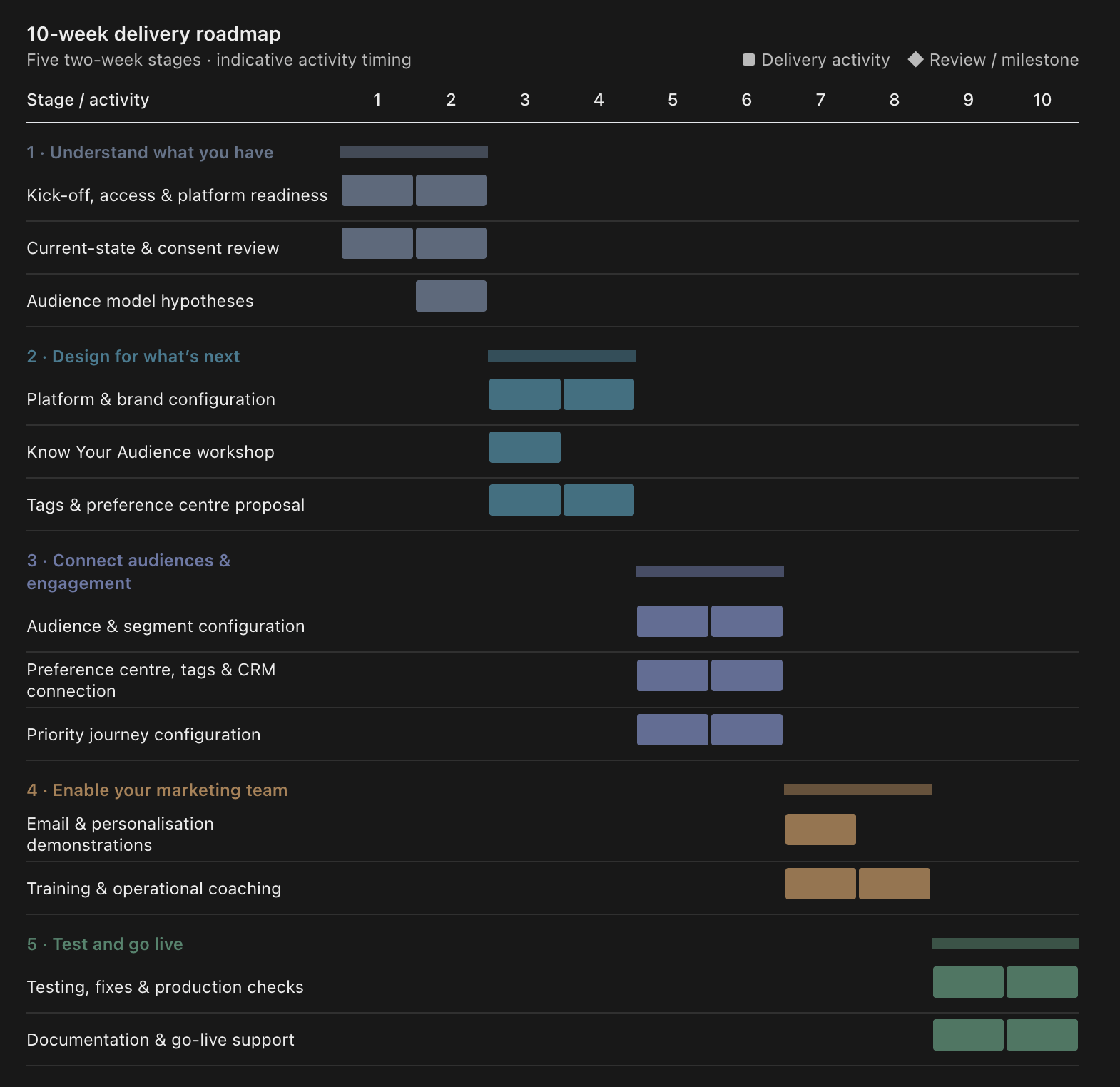
Throughout the project, we use an iterative delivery approach, progressively configuring and demonstrating the solution rather than waiting until the end to reveal a completed implementation. Your team participates in the key workshops, reviews the proposed structures, makes prioritisation decisions and becomes familiar with the platform as it takes shape.
The ten-week structure is intended for a focused migration. More extensive requirements, such as substantial data cleansing, additional integrations or rebuilding a large portfolio of complex journeys, may require further work and should be considered separately.
What will you have when the migration is complete?
By the end of the initial migration, the objective is to have a working Marketing Cloud Next environment that your marketing team can begin using, rather than simply a technically configured platform.
This includes the foundational platform configuration and Salesforce connection, reusable email creation capabilities, an agreed approach to audience segmentation and preference management, and at least one prioritised marketing journey, subject to the agreed delivery scope and capacity. Your team will also have been introduced to the platform’s personalisation, experimentation and reporting capabilities through practical demonstrations and coaching.
Just as importantly, you’ll have a clearer understanding of how your organisation can use Salesforce information to support marketing engagement. The audience archetypes, interest groups and lifecycle stages established during the migration provide a common framework for considering future campaigns and journeys.
Not everything needs to be completed during the initial project. You may still have historical journeys to migrate, additional audiences to configure, data quality improvements to undertake or more advanced personalisation opportunities to explore. These can be prioritised as subsequent activities rather than becoming prerequisites for the initial launch.
This is an important distinction. A successful migration doesn’t necessarily mean every historical capability has been reproduced. It means your organisation has the essential capabilities needed to operate the new platform, with a clear and practical path for extending them.
Where do you go from here?
Moving to Marketing Cloud Next is an opportunity to reconsider how marketing operates within your organisation, but it doesn’t need to become a wholesale reinvention of everything you do.
You can preserve the campaigns and communications that already work, simplify the audience structures that have become difficult to manage and progressively introduce more sophisticated segmentation, personalisation and automation.
As your marketing team becomes more familiar with the platform, new opportunities will emerge. You might introduce additional lifecycle journeys, use dynamic segments to make campaigns more responsive, experiment with different content for different audiences or develop more detailed reporting on engagement.
The audience understanding developed through the migration can also have value beyond email. The same archetypes, interests and lifecycle stages can inform website experiences, broader CRM activities and engagement across other channels, helping the organisation develop a more consistent approach to its relationships.
Ultimately, the aim is to make marketing less dependent on managing lists, preparing data and rebuilding individual communications, and more focused on understanding audiences and delivering relevant engagement.
The future of marketing is not simply a new platform. It’s a better way of connecting with the people who matter to your organisation.
At AlphaSys, we help organisations make that transition through a structured, practical Marketing Cloud Next migration that establishes the essential capabilities first, enables their teams and creates room for marketing to evolve.