
What Does a Good Managed Services + Product Owner Cadence Look Like?
In our previous article, we talked about what it means to become the Product Owner of an important business platform. It’s an opportunity to shape where the product goes, what gets better and where future investment and effort are focused.
The good news is that you don’t need to figure out how to do all of that on your own.
One of the benefits of having a Managed Services partner is having people alongside you who know the technology, understand the history of your solution and can help you make sense of what you’re hearing from the business. You bring your understanding of the organisation, its people and what you’re trying to achieve. We bring our understanding of the technology, what we’re seeing through support and delivery, and experience continually evolving platforms like yours.
A good Product Owner and Managed Services cadence is really about creating a simple rhythm for bringing those perspectives together. It shouldn’t require hours of additional meetings or turn Product Ownership into another job. For many products, it can be as simple as a 30-minute conversation each week, a slightly longer look ahead once a month and a shared view of where we’re going.
Bring us what you’re hearing
You don’t need to arrive at our conversations with a perfectly groomed backlog or a collection of fully formed requirements. Bring us what you’re hearing.
Maybe several people are struggling with the same part of a process. Someone has an idea they think would make their job easier. A team isn’t adopting something we thought they would. There are recurring support requests. A new business priority has emerged. Or perhaps something just doesn’t feel like it’s working as well as it should.
These are all useful signals.
The real value comes from having a regular conversation with someone who carries the voice of the business. Something you raise this week might not feel particularly significant. We talk about it, perhaps help in the moment, and move on. Then something similar comes up next week. Individually, neither moment may have justified changing the product, but together they start to tell us something.
This is where we can step above the individual requests and look for themes. What are we seeing? What does it really mean? How important does it feel? And what, if anything, should we do about it?
Over time, those regular conversations build shared context. Eventually we might find ourselves saying,
we’ve talked about this a few times now; this feels like something worth addressing. Let’s plan for it next month.
That’s continuous improvement in practice.
Sometimes the answer is more than one thing
Identifying a theme doesn’t mean the answer is automatically to build something.
Perhaps people aren’t aware of something the platform can already do, so we can train them on a better way to work now. There might be a process we can change immediately to make things easier. We might also identify a small product improvement worth making next month while recognising that there is a larger capability we want to come back to later.
The response to one theme could quite reasonably be:
- train this now,
- change this process,
- build this next and
- release something larger later.
This is where having the business and technology perspectives together becomes valuable. You know what people are experiencing and what the organisation is trying to achieve. Your Managed Services partner can help you understand what the technology already does, what could change, what other parts of the solution might be affected and what different options might look like.
Neither side needs to arrive with the answer. We work it out together.
A simple 30-minute weekly rhythm
For a product with a steady flow of business needs and opportunities, the cadence itself can be remarkably simple. Thirty minutes, once a week, starting with the same question:
What’s new?
This is your opportunity to bring the voice of the business into the conversation. What have you heard since we last spoke? What’s changed? Has something come up repeatedly? Is there a new pain, opportunity or priority we should know about? We don’t need to solve everything there and then. Sometimes the most useful thing we can do is hear it, talk about it and see whether it connects with anything else we’re seeing.
From there, loop through what’s In Progress. This shouldn’t become a detailed project status meeting. Give a quick update, identify anything that’s blocked and surface any decisions or input we need from you. If everything is moving, keep moving.
Then look at what’s next. Is the work sitting in the current month still practical to achieve? Have priorities changed? Is there too much there? Leave some stretch items if that’s useful, but be realistic about what the delivery team and the business can actually deliver, test, adopt and absorb. Move the balance into future months rather than allowing the current month to become an ever-growing wish list.
Do as much of that as you can in 30 minutes. Then stop and do it again next week.
The board shouldn’t only move during the meeting either. Both the Product Owner and Managed Services team should review it beforehand and come prepared. Updates, housekeeping and moving obvious items can happen in the background during the week. The meeting is valuable conversation time, not board administration time.
Make the roadmap something you can move
A simple Kanban-style board can become one of the most useful tools in the relationship. Trello, Monday, Confluence or whatever shared tool you already use can work.
The useful part is the model behind it. Rather than one enormous backlog, use time as part of the structure. Start with a What’s New? column for emerging ideas, pains, opportunities and themes. Upcoming months become planning buckets, with In Progress for active work and previous months retained as a history of what has been completed.
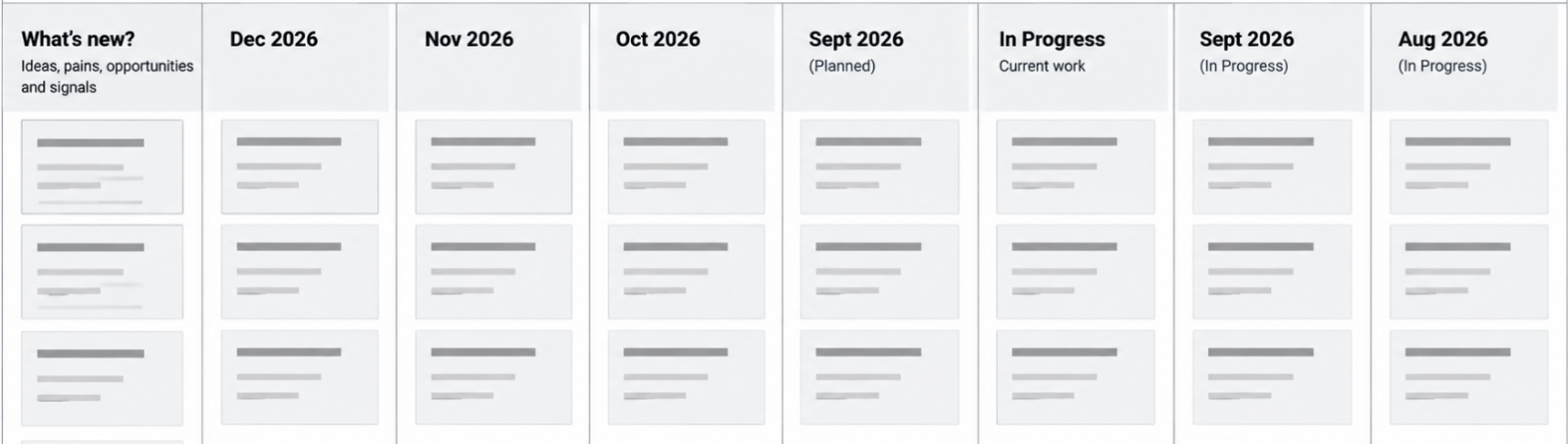
The months aren’t fixed commitments. They help us organise priorities and have practical conversations about capacity. Something might sit in What’s New? while we learn more, then become important enough to say, let’s put that into next month. Keep some stretch items in each month, but if there is clearly too much, move things forward.
Over time, the board gives everyone a simple view of what we’re hearing, what’s coming next, what’s happening now and what we’ve already achieved.
The conversation finds the themes. Time gives them a place. The board keeps them moving.
Once a month, look a little further ahead
Once a month, make the weekly session an hour. Use the first 30 minutes for exactly the same rhythm you use every week: what’s new, what’s in progress and what’s next. Then use the second half to lift your eyes a little further.
Look properly at next month and the month after that. Given everything we’ve learned over the last few weeks, do the things sitting there still feel right? Are themes emerging that now deserve a place? Has something become less important? Are there dependencies we need to prepare for? Is the amount of change realistic for the capacity available?
This is also a useful opportunity to look at pace. Are we moving at roughly the rate we expected? Is there room to bring something forward? Are we consistently carrying too much from one month into the next? Is there a larger enhancement on the horizon that might need additional investment or planning?
This isn’t about locking down another project plan. It’s about maintaining enough certainty about what comes next that everyone can move with confidence, while leaving enough flexibility to respond to what we learn.
Plan for value and the capacity for change
A Managed Services relationship has capacity. So does the business. Both matter.
There may be enough delivery capacity to make ten changes, but if the business only has the capacity to test, adopt and absorb three, delivering ten isn’t necessarily success. Equally, a Product Owner might identify twenty genuinely valuable opportunities, but that doesn’t mean they all need to happen immediately.
The board makes those trade-offs visible. We can keep some stretch items in the current month and pull them forward if things move faster than expected. We can move other things into future months knowing they haven’t been forgotten. And when something genuinely becomes more important, we can bring it forward and consciously move something else.
That is very different from continuously adding things to a backlog and hoping we eventually get to them. We’re organising change around value, impact and the capacity to absorb it.
Don’t combine Product Owner cadences
If you have multiple Product Owners across a connected ecosystem, it can be tempting to bring them all into the same weekly Managed Services conversation. Generally, we wouldn’t.
Each Business Product Owner benefits from having their own regular conversation because their product, users and needs are different. A CRM Product Owner might talk about processes, reports, flows and configuration, with many of those conversations leading to product change. A Marketing or Digital Product Owner might talk about audiences, engagement, campaigns, conversion and analytics, with the conversation leaning more towards strategy, advice and making better use of the capabilities they already have.
The person they meet with from the Managed Services team may be different too. The CRM Product Owner might benefit from someone who knows their solution and can help shape functional change, while the Marketing Product Owner may get more value from someone bringing marketing, digital and engagement expertise. The cadence should connect the Product Owner with the people best equipped to help them make their product better.
IT and Data Product Owners can work differently again. They are often more on demand, becoming involved when a need, opportunity or risk emerges: we need to think differently about PII, or I think we’ve identified a data risk. Those conversations may need architecture, data or integration expertise rather than a standing weekly cadence.
Combining all of this into one meeting can actually reduce its value. People spend time listening to conversations that don’t need them, while the conversations that do matter get less time and less access to the right expertise. Collaboration doesn’t require everyone to be in everything.
Keep the individual cadences focused and bring people together when there is something worth connecting. For closely related products, an additional monthly cross-product conversation can still be useful for looking ahead at dependencies and shared impacts, but it should complement the individual relationships rather than replace them.
Give each Product Owner the conversation they need, with the people they need, then connect those conversations when it matters.
Keep it simple and keep talking
That’s really what a good Managed Services and Product Owner cadence looks like. And it doesn’t need to look identical for every product.
Where there is a steady flow of business change, start every week with what’s new? Listen for the voice of the business and the themes beginning to emerge. Quickly check what’s in progress and clear anything getting in the way. Look at what’s next and make sure the current month remains realistic. Keep the board moving in the background rather than spending your meeting administering it.
Once a month, spend another 30 minutes looking ahead and shaping the next couple of months. Where there are multiple related products, occasionally bring those Product Owners together to look across the ecosystem without turning every decision into a committee decision.
Then do it again next week.
The value isn’t in the meeting itself, the Kanban board or having the perfect backlog. The value is in the continuity of the conversation. Something that seems small today can connect with something we hear next week, and over time those signals help us recognise where attention and investment will create the most value.
You don’t need to manage all of that alone. Bring us what you’re hearing from the business and where you want to go. We’ll bring what we’re seeing through support and delivery, what we know about the technology and the experience to help you give it shape.
Keep talking, keep learning, and together we’ll keep making the product better.