
Know Your Audience:
Design for Audiences – Not for content
Most organisations understand the importance of knowing their audience. They invest in research, develop personas, map customer journeys and document the needs of the people they want to engage. Yet despite the effort involved, much of this work is rarely revisited once the initial website, campaign or digital transformation project is complete.
The problem isn’t that audience research lacks value. It’s that traditional approaches often produce something difficult to maintain and even harder to use in everyday decision-making. What begins as an exercise in understanding people can become a collection of documents that teams refer to during a project, but rarely use as part of their ongoing marketing and digital activities.
At AlphaSys, we believe audience understanding should be a repeatable business practice, not a deliverable produced during a project. Our Know Your Audience methodology uses a simple, three-dimensional model that helps organisations make practical decisions about their websites, marketing, content and digital experiences. Rather than trying to describe every possible type of person, we focus on a small number of meaningful distinctions that influence how organisations engage their audiences.
Know Your Audience is an important part of how we approach building sustainable digital systems. Understanding audiences comes before designing content structures, navigation and digital experiences. But the value of this work extends well beyond a website project. The same audience understanding can inform marketing, social engagement, email communications, CRM journeys and the ongoing decisions organisations make about how to engage their communities.
Thinking about personas differently
Traditional personas attempt to describe an audience through a collection of representative individuals, often including their age, occupation, motivations, interests, challenges and behaviours. While these can be useful for developing empathy, they can also become unnecessarily complicated. Organisations invest considerable time developing detailed personas that marketing teams rarely revisit once the initial project is complete.
At AlphaSys, we think about personas differently. As part of our Know Your Audience discovery process, we use a simple collection of eight recognisable personas to help you think about the different people who engage with your organisation.
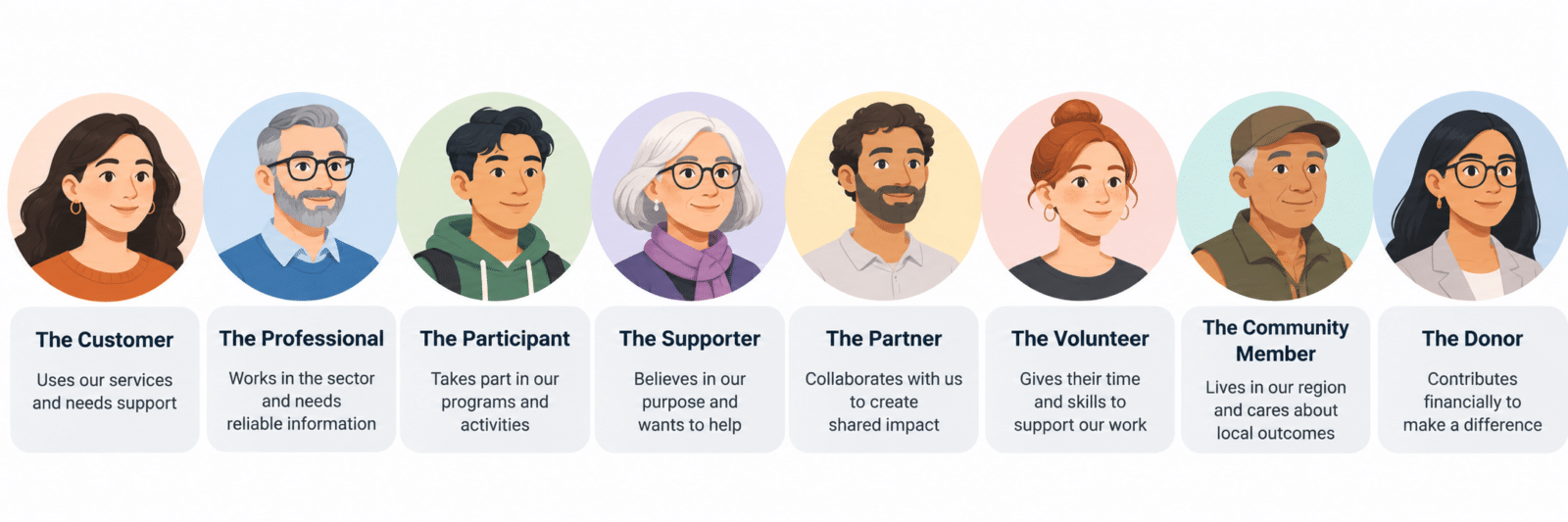
Rather than asking you to develop detailed fictional profiles, we simply ask you to consider these eight personas and tell us which ones align with your audiences and why. You might recognise several immediately, find that some overlap, or identify people who don’t fit neatly into any of them. That’s all useful information.
The purpose isn’t to create another set of personas for your organisation to maintain. It’s to start a practical conversation about who your audiences are, how they relate to your organisation and what makes them different. From that conversation, we can begin identifying the three or four meaningful audience archetypes that will form the foundation of your engagement model.
Introducing the 3D Audience Model
Our Know Your Audience methodology separates audience understanding into three dimensions: archetypes, interests and engagement lifecycle. Each answers a different question, and together they provide a practical way to understand who we’re engaging, what matters to them and how their relationship with the organisation should influence the experience we provide.
The first dimension is archetypes: who are they? Archetypes describe the broad groups of people who interact with an organisation, such as customers, members, supporters, professionals, partners or community participants. The objective isn’t to describe every characteristic of each person, but to identify the meaningful differences between groups that influence how the organisation should engage them.
The second dimension is interests: what matters to them? Interests describe the subjects, services, opportunities or outcomes people care about. Unlike traditional personas, interests aren’t permanently attached to a particular archetype. Two very different groups of people might share an interest, while people within the same archetype might care about completely different things. Separating interests from archetypes allows us to recognise these relationships without creating a new persona for every possible combination.
We deliberately encourage organisations to identify just three or four archetypes and three or four interests. This can be challenging because there are always exceptions, overlapping relationships and additional groups or topics to consider. However, the discipline forces us to focus on distinctions that actually influence engagement decisions, rather than attempting to catalogue every variation.
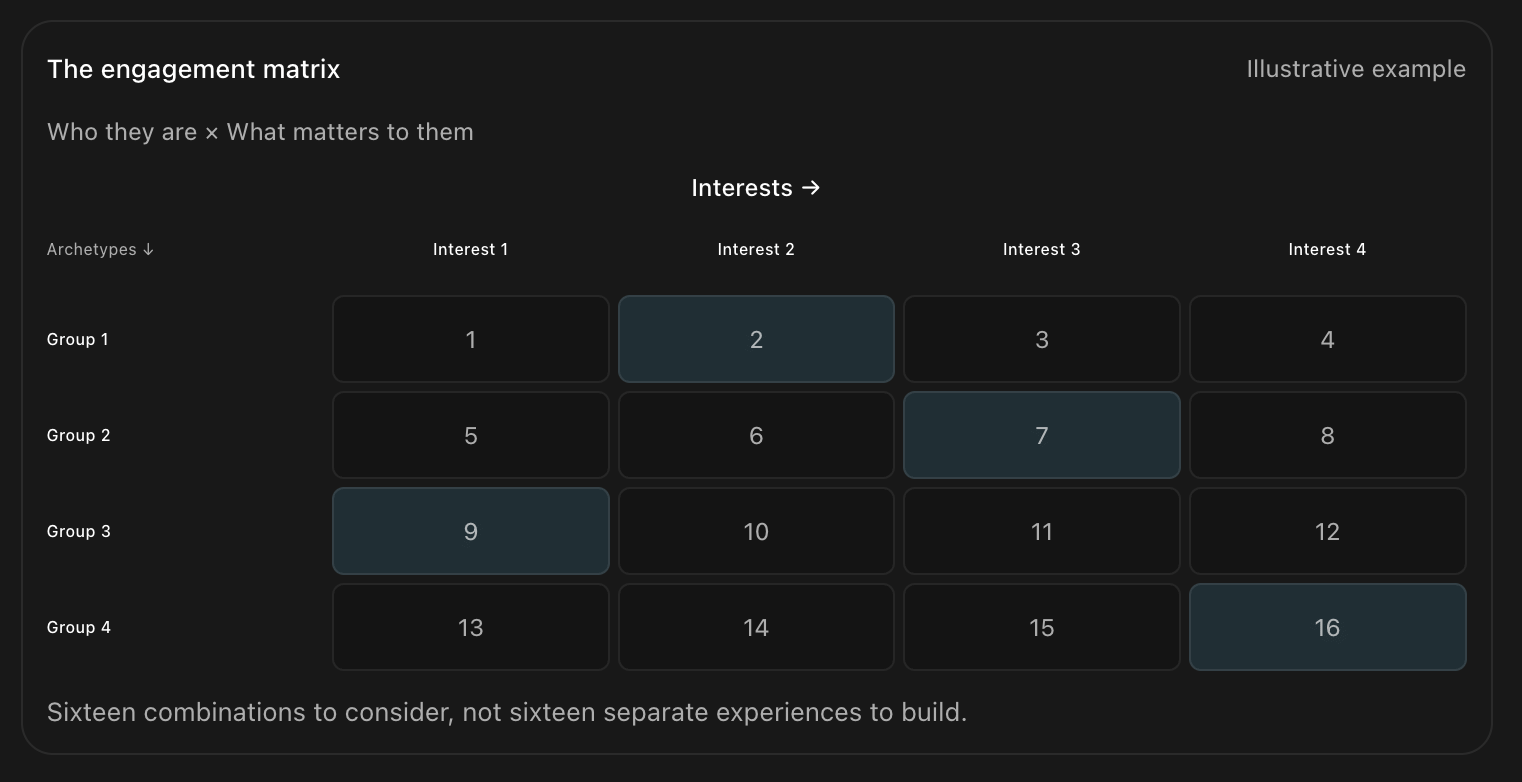
Combining archetypes and interests creates a simple two-dimensional engagement matrix. With four archetypes and four interests, we have 16 possible audience combinations, each representing a different engagement opportunity. Not every combination will be equally important, and some may have little relevance to the organisation. Understanding those differences is part of what makes the matrix useful.
The third dimension is engagement lifecycle: where are they in their relationship with us? Someone discovering an organisation for the first time has very different needs from someone who has been actively involved for years. Their familiarity, trust, expectations and willingness to engage will all influence the experience they need.

A simple lifecycle might move through five stages: Unaware, Discover, Engage, Participate and Advocate. At the earliest stages, audiences are often anonymous. They may discover an organisation through search, social media, referrals or independently exploring its website. We don’t necessarily know who they are, and we cannot assume they will give us much time to establish relevance. As relationships develop, people may become known to the organisation, allowing us to provide more relevant experiences and proactive communications where appropriate permissions exist.
The lifecycle isn’t necessarily linear, and someone can be at different stages with different services or interests. Its purpose is to help us consider the nature of the relationship rather than assuming every visitor or contact should receive the same experience. When combined with the engagement matrix, it adds context to each audience combination and helps us understand how engagement might change as relationships develop.
Simplicity is a deliberate design decision
One of the hardest parts of our methodology is resisting the temptation to add more detail. There is always another archetype to consider, another interest to capture or another exception that doesn’t fit neatly into the model. Each addition can make the framework feel more accurate, but it also increases the number of combinations that teams need to understand and manage.
More fidelity doesn’t automatically produce better decisions. In many cases, it simply produces a more complicated model that becomes increasingly difficult to maintain. A framework with dozens of audience categories might describe an organisation’s audience in considerable detail, but if marketing teams cannot confidently use it to make everyday decisions, that additional complexity provides limited practical value.
A four-by-four engagement matrix provides 16 audience combinations. Considering these against five lifecycle stages introduces multiple perspectives on engagement, but it doesn’t mean an organisation needs 80 different campaigns, journeys or website experiences. The model is intended to guide decisions, not multiply deliverables.
Instead, we look for common needs that can be served through shared experiences, meaningful differences that justify more tailored engagement, and audience combinations that matter most to the organisation’s objectives. The result is a manageable framework that teams can remember, discuss and apply consistently, without needing to return to a large collection of research documents.
From audience understanding to digital decisions
The real value of Know Your Audience emerges when the engagement matrix becomes a practical tool for deciding how an organisation should communicate and interact with people. Rather than starting with the content we have or the channels available to us, we can begin with the audiences we’re trying to engage and consider which experiences are most appropriate for them.
For example, some combinations within the engagement matrix will naturally be more aligned to the website. These may be people exploring independently, looking for information or discovering the organisation for the first time. Other combinations may be better served through direct email, particularly when an established relationship exists and we understand the person’s interests. Social media might be particularly valuable for reaching people who don’t yet know the organisation, introducing new opportunities or encouraging audiences to explore an experience.
The engagement lifecycle adds an important perspective to these decisions. At the early stages, people are often anonymous and responsible for finding their own way. They may arrive through a search result, follow a link from social media or explore the website without having any prior relationship with the organisation. For these visitors, clear navigation, relevant language, discoverability and a strong sense that they’re in the right place are essential.
As relationships develop, engagement can become more proactive. Known audiences who have provided appropriate permissions can be guided through relevant email communications, personalised experiences, invitations and opportunities aligned to their interests. The organisation can take a more active role in helping people discover what matters to them, rather than relying entirely on independent exploration.
These differences also influence how forgiving audiences are when an experience doesn’t quite meet their expectations. An existing customer or supporter who already trusts an organisation may be prepared to work through confusing navigation, unfamiliar terminology or an imperfect website experience because they have a reason to persist. Someone arriving for the first time has no such commitment. If the content, language or presentation doesn’t feel relevant, they can leave just as quickly as they arrived.
This is why designing digital experiences around an organisation’s internal structure or existing content library can be so limiting. People don’t arrive thinking about departments, business units or content ownership. They arrive with their own interests, expectations and objectives. Understanding the audience combinations that matter most allows us to make deliberate choices about navigation, content, communication and experience design, with particular attention to the people who have the least familiarity and trust.
The principle is simple: design for the audience, not the content you happen to have.
Keep Marketing Simple
Knowing your audience is only valuable if it changes what you do. That’s why we connect the 3D Audience Model with another AlphaSys principle: Keep Marketing Simple. Rather than beginning with complex campaign architectures or elaborate automation journeys, we believe marketing can follow a practical, repeatable process built around four activities.
First, choose your audience. Use the engagement matrix and lifecycle to identify who you want to engage, what interests them and what outcome you want to help them achieve. This creates a clear starting point for the activity and helps avoid the temptation to communicate everything to everyone.
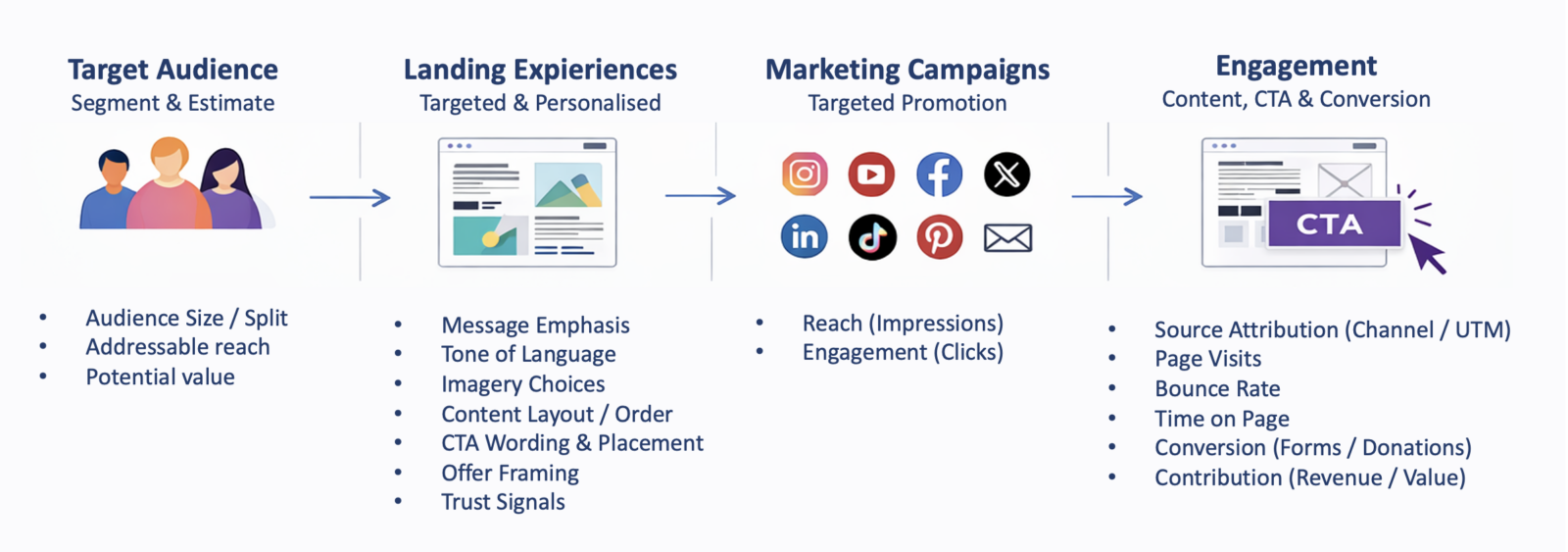
Next, create an experience that provides something valuable for that audience. This might be an article, event, service, resource, donation opportunity or digital interaction. The important consideration is that the experience serves a genuine audience need and provides an appropriate next step. By focusing on the experience before the promotion, we make sure there is something worthwhile for people to engage with when they arrive.
Once the experience exists, promote the experience through the channels most appropriate for the audience. Depending on the archetype, interest and lifecycle stage, that might involve search, social media, email, partners or other communication channels. Different audiences may respond to different promotional approaches, even when the underlying experience is the same.
Finally, measure performance, recognising that attracting people to an experience and providing a valuable experience are two different objectives. Measuring them independently is essential if we want to understand what worked, what didn’t and where improvement is needed.
Promotion performance and experience performance are different
A campaign can do an excellent job attracting the intended audience to an experience that doesn’t work particularly well. Equally, an excellent experience may receive little engagement because the promotion failed to reach the right people or give them a compelling reason to participate.
If we measure only the final conversion or outcome, these situations can appear to be the same problem. A disappointing result might lead a team to change its advertising, messaging or audience targeting when the real issue is the experience itself. Alternatively, teams may invest in redesigning an experience that already works well, when the real opportunity is to improve how people discover it.
Separating promotion performance from experience performance makes these decisions clearer. Promotion measurement helps us understand whether we reached the intended audience and encouraged them to visit or participate. Experience measurement helps us understand whether the people who arrived were able to achieve the intended outcome.
These measures serve different purposes and often point to different improvements. Together, they provide a more useful picture of digital engagement than a single campaign result, and they make ongoing optimisation more deliberate and effective.
An approach that works beyond the website
Know Your Audience isn’t exclusively a website design methodology. It’s a shared approach to digital engagement that can inform content architecture, marketing strategy, CRM segmentation, personalised communications, service design and continuous improvement.
For website projects, the model helps establish which experiences matter most, how information should be organised and where visitors need greater clarity or guidance. It encourages us to build navigation and content structures around audience needs rather than internal departments or the organisation’s existing collection of content.
For marketing teams, it provides a repeatable way to choose audiences, identify relevant experiences and select appropriate promotional channels. Rather than starting each campaign from scratch, teams can use a consistent understanding of audience combinations and lifecycle stages to guide their planning and evaluate performance.
For CRM and marketing automation, the model provides a foundation for meaningful segmentation without requiring an ever-growing collection of individual audience profiles, mailing lists and journeys. Rather than maintaining a separate list for every audience, interest and campaign, organisations can use structured information to identify relevant audiences when needed. Understanding someone’s interests helps determine what might be relevant to them, while consent and communication preferences determine how we can appropriately engage them.
This becomes particularly valuable as organisations adopt more capable marketing platforms. Dynamic segmentation, personalised experiences and automated journeys can build on a simple, consistent understanding of audiences rather than introducing additional complexity. We explore this application further in The Future of Marketing Is Here, using Salesforce Marketing Cloud Next as an example of how technology can support an audience-led engagement approach.
Perhaps most importantly, the model gives an organisation a shared language for discussing engagement. Website teams, marketers, service owners and leadership can use the same framework to understand who they’re trying to reach, which experiences matter and where investment should be prioritised.
As the organisation learns more about its audiences, the archetypes, interests and engagement priorities can be reviewed and refined. The framework itself remains consistent, allowing the organisation to improve its understanding without continually reinventing its approach.
Make audience understanding a business practice
Digital engagement is not something an organisation designs once and then considers complete. Audiences change, interests evolve, relationships develop and the experiences people expect continue to change. A sustainable digital system needs an equally sustainable approach to understanding the people it serves.
Our Know Your Audience methodology is designed to make that understanding practical. Beginning with a simple discovery conversation, we identify three or four archetypes, three or four interests and an engagement lifecycle that together provide a manageable foundation for decision-making. Combined with a repeatable process for choosing audiences, creating experiences, promoting them and measuring performance, the model becomes something teams can use every day rather than something they revisit only during a major project.
This simplicity isn’t based on the assumption that audiences themselves are simple. It’s a recognition that the frameworks we use to understand and engage people must be manageable if they’re going to remain useful over time. The objective is not to capture every possible variation, but to make better decisions consistently and improve those decisions as we learn.
The measure of a good audience model isn’t how many characteristics it can describe. It’s whether people actually use it to make better decisions.
Before deciding what content to create, which channels to use or what technology to implement, start by understanding who you’re trying to engage, what matters to them and where they are in their relationship with you. From there, designing meaningful experiences and improving their performance becomes a far more deliberate, repeatable and sustainable practice.